

Food Production Certificate vs Culinary Certificate: What Is the Difference

You are kindly requested to fill out this form and select the course at IIIC that interests you so that we may get in touch with you as soon as admissions are open.
Anyone comparing a food production certificate course india option against something labelled culinary arts quickly finds that nobody agrees on what either term means. The names are used loosely across the training market, and the difference that matters is not the label but what the programme actually contains. This guide sets out how to read the two, and which one IIIC runs at its Kollam campus.
Key Takeaways
- The two labels are not standardised, so judge a programme on its kitchen hours, its assessment method and its accreditation rather than on its title.
- Food production usually signals a production kitchen focus: volume, consistency, hygiene and the brigade discipline a commercial kitchen runs on.
- Culinary arts usually signals a broader treatment that can include technique, presentation and cuisine study, but the term carries no guaranteed content.
- IIIC runs a food production certificate for commis chefs at its technician tier, which accepts a school leaving qualification and has thirty seats.
Why the Two Labels Do Not Mean What People Assume
Start with the uncomfortable fact. Neither term is protected or standardised in India, so two programmes with identical titles can differ enormously in what they teach and what a graduate can actually do at the end.
That makes the label a poor basis for a decision. A food production certificate course india applicants find at one provider may include more genuine kitchen technique than a culinary arts programme somewhere else, or considerably less.
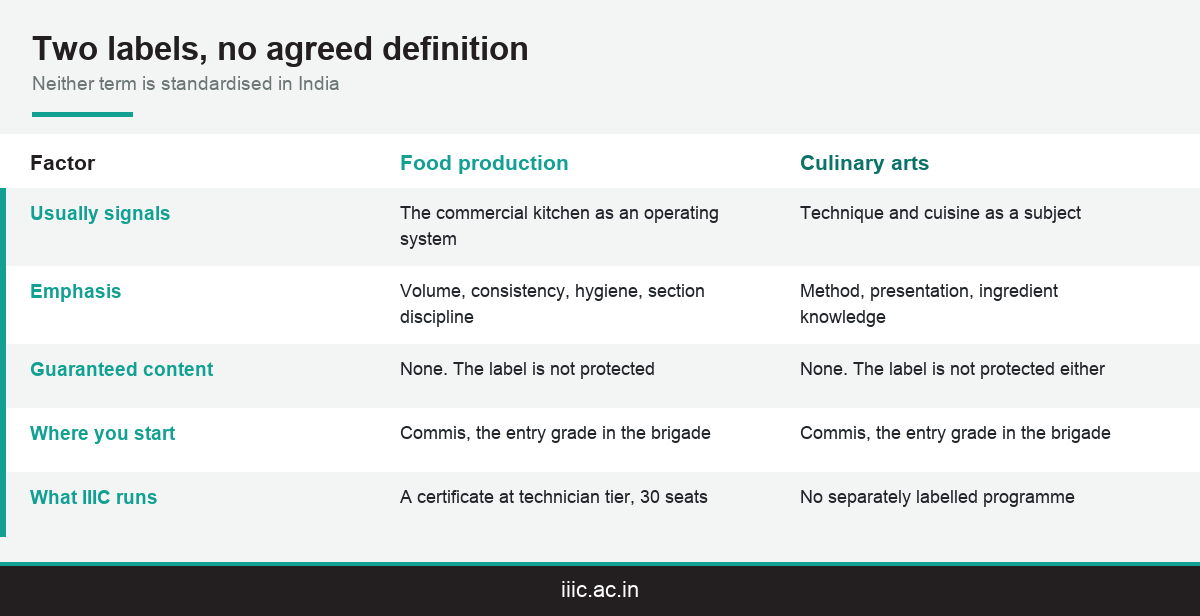
The broad convention, where one exists, is that food production leans toward the commercial kitchen as an operating system: volume cooking, consistency, hygiene discipline and the section based structure a real kitchen runs on.
Culinary arts, again by convention, leans toward technique and cuisine as a subject: method, presentation, ingredient knowledge and sometimes a broader treatment of food culture alongside practical skill.
In practice most credible programmes contain both, because a kitchen needs technique and a technician needs volume discipline. Separating them cleanly is a marketing convenience more than an industry reality.
What does not vary is where you start. The brigade system most professional kitchens still use puts every new entrant at commis level regardless of which label their certificate carried.
So the practical question is not which term to search for. It is what the programme behind either term actually gives you, and the rest of this guide covers how to work that out.
There is a second reason the labels blur. Providers name programmes to match what applicants are searching for, which means the title tells you about the marketing rather than about the syllabus, and it changes as search behaviour changes.
What to Judge a Kitchen Programme On Instead
Four things separate a serious kitchen programme from a short course with a good brochure, and all four can be established before you enrol.
Kitchen hours come first. Ask how many hours a student spends cooking, and how many students work a station at once. A programme where six people watch one person cook is a demonstration, not training.
Food safety grounding is second and is not optional. Standards enforced by bodies such as the Food Safety and Standards Authority of India govern commercial kitchens, and a programme that treats hygiene as a module rather than a habit is teaching the wrong thing.
Assessment method is third. A programme assessed by cooking to a standard under time pressure produces people who can work service. One assessed by written paper may not, whatever its title says.
Accreditation is fourth. Ask which national or sector skill body stands behind the certificate and confirm it independently, because in this part of the training market the spread of quality is unusually wide.
IIIC is affiliated with the National Skill Development Corporation across thirteen sectors rather than construction alone, which is what places its kitchen programme inside the same recognised structure as its technical ones.
The full record sits on IIIC’s accreditation and affiliation page. Take the same question to every provider you shortlist, and treat reluctance to answer as an answer in itself.
A fifth question is worth adding if you can get it answered. Ask what a graduate leaves with beyond the certificate, because a documented set of dishes cooked to a standard, and a supervisor willing to speak to your first employer, carry real weight at the point of hiring.
What IIIC Actually Runs, and at Which Tier
IIIC does not offer two competing certificates under different labels. It runs one kitchen programme, a certificate in food production for commis chefs, and it sits at the institute’s technician tier.
That tier is the important detail. Technician programmes accept a school leaving qualification rather than a degree, and carry thirty seats each, which makes this a realistic route for applicants who want to start earning without three or four more years of study first.
Current terms are on the commis chef certificate page, and IIIC has also published a longer written guide covering curriculum and progression in more depth than a comparison page can.
That guide is IIIC’s commis chef certificate guide. It is the right next read once you have decided the kitchen is genuinely where you want to work.
The training itself happens in the food production lab, a working training kitchen rather than a classroom with equipment in it. IIIC puts the hands on share of its training at roughly seventy five percent across the institute.
Service side exposure sits alongside it. The food and beverage service lab is a training restaurant and bar, which matters because a cook who understands service timing is more useful than one who does not.
So if you are comparing labels, the honest answer for this institute is that the programme carries the food production name and is built around the commercial kitchen discipline that name conventionally implies.
If your interest is specifically in cuisine study or presentation rather than kitchen operation, say so when you enquire. The admissions team can tell you how much of that the current syllabus contains, which is a more reliable answer than inferring it from the programme name.
Where Either Route Actually Leads
Whichever label your certificate carries, the career that follows is the same one, and it is worth understanding before you enrol rather than after.
You enter at commis level, working under a chef de partie on a section. The work is preparation, execution to a set standard, and speed under service pressure. This is where technique is genuinely built.
Progression runs from commis through chef de partie, sous chef and upward, and it is earned through kitchen years rather than through further certificates. It is a long ladder and a real one.
The employer base is wider than restaurants. Hotels, resorts, contract catering, hospitals, campuses and corporate operations all run kitchens, and the institutional side offers steadier hours than most applicants expect.
IIIC names Club Mahindra and Le Meridien among more than fifty recruiting organisations across its programmes on the placement outcomes page, and the hospitality names on that list are the relevant ones for this route.
Some chefs later move sideways rather than up, into catering businesses, food product work or teaching. A recognised certificate helps in all three, because each involves somebody else having to trust your food safety grounding.
What none of it changes is the entry point. Everybody starts at commis, and the value of a certificate is that you arrive there with technique and hygiene discipline already in place rather than learning both on somebody else’s service.
Conclusion
Comparing a food production certificate course india option against a culinary arts programme is a comparison of marketing labels rather than of qualifications, because neither term is standardised. Judge on kitchen hours, food safety grounding, assessment method and verifiable accreditation instead. IIIC runs one kitchen programme, a food production certificate for commis chefs at technician tier, taught in a working training kitchen on its residential Kollam campus. Call 8078980000 or apply online at iiic.ac.in to check the current intake.
Related Reading
Frequently Asked Questions
What is a food production certificate course in India?
It is a kitchen training programme, conventionally focused on commercial kitchen operation: volume cooking, consistency, hygiene discipline and the section based brigade structure that professional kitchens across the industry still run on day to day.
Is a culinary certificate different from a food production certificate?
In principle culinary leans toward technique and cuisine while food production leans toward commercial kitchen operation. In practice neither term is standardised in India, so the programme content matters far more than the label on it.
Which one does IIIC run?
IIIC runs a certificate in food production for commis chefs at its technician tier. It does not offer two competing kitchen certificates under different labels, so the choice at this institute is about tier rather than about naming.
What qualification do I need to join?
The technician tier accepts a school leaving qualification rather than a degree, with thirty seats per programme. That makes it a realistic route for applicants who want to start earning without several more years of full time study.
How should I compare kitchen programmes?
Ask four things: how many hours students spend cooking and at what student to station ratio, how food safety is taught, how the programme is assessed, and which skill body stands behind the certificate you would receive.
Where does the training actually happen at IIIC?
In a working training kitchen on the Kollam campus, alongside a training restaurant and bar for service exposure. IIIC puts the hands on share of its training at roughly seventy five percent rather than treating practice as an extra.
What job will I start in after the certificate?
Commis, the entry grade in a kitchen brigade, working under a chef de partie on one section. Everyone starts there regardless of prior education, and it is where cooking technique is genuinely built over the first years.
Who employs certificate holders besides restaurants?
Hotels, resorts, contract catering firms, hospitals, campuses and corporate operations all run commercial kitchens of their own. The institutional side in particular tends to offer steadier hours and more predictable volumes than restaurant work usually does.
Is accommodation available if I am relocating?
Yes. The Kollam campus is residential, with hostel accommodation alongside a cafeteria, a central library and a counselling cell. You can see the full list on campus facilities before you commit to an intake cycle.
How do I apply for the certificate?
Applications run through an online form, the ATEiiic entrance assessment, a group discussion and then an interview. Current dates sit on how to apply to IIIC, and seats are capped at thirty per programme at this tier, so early application genuinely helps.