

Hospitality and Culinary Careers at IIIC: Which Route Fits You

You are kindly requested to fill out this form and select the course at IIIC that interests you so that we may get in touch with you as soon as admissions are open.
A post graduate hospitality management kerala search and a search for chef training usually come from the same person at different moments, which is exactly the problem. Hotels and professional kitchens are related industries and separate careers, entered through different qualifications at different levels. IIIC runs a route for each. This hub explains the difference so you apply to the one you actually want.
Key Takeaways
- The management route is a one year postgraduate programme in IIIC’s top tier, aimed at graduates heading for operational leadership across hotel departments.
- The kitchen route is a certificate in food production at technician level, aimed at people who want to cook professionally and start earning sooner.
- Entry requirements differ sharply, and for most applicants eligibility settles the question before preference does.
- IIIC teaches both on the same residential Kollam campus, with dedicated kitchen, service, front office and housekeeping training facilities.
Two Industries That Share a Building and Not a Career
A hotel contains a kitchen, so it is easy to assume that training for one prepares you for the other. It does not, and the assumption costs applicants time more often than any other confusion in this field.
The management side is about running an operation: rooms, occupancy, service standards, staffing, cost control and the guest experience across departments that each have their own rhythm and their own failure modes.
The kitchen side is a craft discipline with its own progression ladder. The brigade system that most professional kitchens still run on defines a clear sequence of roles, and you enter it at the bottom regardless of what else you have studied.
The daily experience differs as much as the content. Management work is scheduled, meeting heavy and increasingly analytical. Kitchen work is physical, timed to service and judged in minutes rather than in quarters.
Both are genuine careers with real progression, and neither is the senior version of the other. A head chef and a general manager are peers who arrived by different routes, not two rungs on one ladder.
IIIC has already published a comparison of two adjacent hospitality labels that confuse applicants in a similar way. IIIC’s comparison of the two hospitality routes is worth reading alongside this page.
What this hub adds is the kitchen side of the picture, which that earlier comparison does not cover, and the mapping from each route to the specific IIIC programme that leads into it.
The confusion is made worse by how the industry talks about itself. Job titles overlap, small properties combine roles that large ones separate, and a single word like hospitality is used to describe everything from front desk work to catering contracts.
That is why it is worth anchoring the decision to something concrete. Ask yourself which part of a hotel you would want to be standing in at eight in the evening on a busy Saturday, because that answer maps to a route far more reliably than any aspiration about the sector in general.
The Management Route: One Year at Postgraduate Level
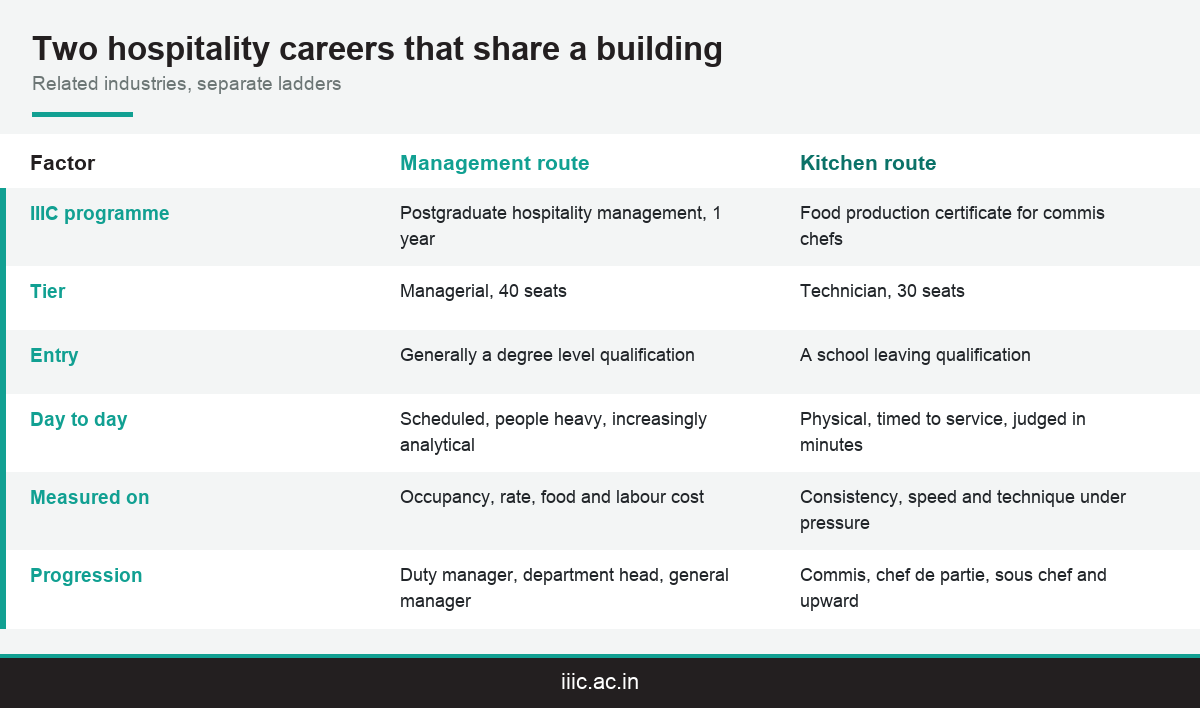
IIIC runs seven programmes at its managerial tier, and hospitality management is one of them. The format is one year with forty seats, and the tier generally expects a degree level qualification at entry.
The purpose of that year is breadth with accountability. A hospitality manager has to understand rooms, food and beverage, front office and housekeeping well enough to hold them to a standard without personally performing any of them.
Revenue and cost literacy sit underneath all of it. Occupancy, average rate, food cost percentage and labour cost are the numbers a manager is measured on, and comfort with them separates a supervisor from a manager.
Current terms are on the PGP HM programme page. Read it for eligibility and intake dates, since programme pages are revised between cycles and this article is not.
IIIC also publishes a written guide to the hotel side of the industry. IIIC’s hotels fees and careers guide covers the discipline more broadly than a decision hub can, and is the better read if the field itself is new to you.
Kerala gives this route an unusually broad employer base. Tourism, backwater and heritage properties, business hotels, hospitals and institutional catering all need the same core operational skills.
The Gulf market extends that further. Hospitality operations transfer across borders more cleanly than many disciplines, which is one reason the route holds its appeal for applicants planning to work abroad at some stage.
What the year does not do is make you a chef, and it is worth being explicit about that. A management programme includes exposure to kitchen operations so that you can supervise them credibly, but supervising a kitchen and cooking in one are different competencies built over different timescales.
People management is the part most applicants underestimate. Hospitality runs on shift teams with high turnover, and the manager who succeeds is usually the one who can recruit, train and hold a team together rather than the one with the best grasp of the revenue model.
The Kitchen Route: A Certificate at Technician Level
IIIC runs four programmes at its technician tier with thirty seats each, and the food production certificate for commis chefs sits among them. It is the fastest route into a professional kitchen the institute offers.
The tier is the point. Technician programmes accept a school leaving qualification rather than a degree, which makes this an option for applicants who want to start earning without first completing three or four more years of study.
Current terms sit on the commis chef certificate page, and IIIC has published a fuller written guide to the programme as well, covering curriculum and career progression in more depth.
That guide is IIIC’s commis chef certificate guide, and it is the right next read for anybody who has already decided the kitchen is where they want to be.
One thing to be clear about before you choose this route. Professional kitchens are physically demanding and run on unsocial hours, and the people who thrive are the ones who genuinely enjoy the pace rather than the ones who liked cooking at home.
What a commis chef actually does
A commis is the entry grade in a professional kitchen brigade, working under a chef de partie on a specific section. The work is preparation, execution to a set standard and speed under service pressure. It is where technique is built, and every senior kitchen role in the industry starts here regardless of prior education.
Why the certificate still matters
You can enter a kitchen without formal training, and many people do. What a certificate adds is structured technique, food safety grounding and a credential an employer recognises, which matters most when you are applying to a property with a formal hiring process rather than a small independent kitchen.
Where the route leads over time
Progression runs from commis through chef de partie, sous chef and upward, and it is earned through kitchen years rather than through further certificates. Some chefs later move sideways into management, catering businesses or teaching, but the craft ladder is the primary path and it is a long one.
Why Eligibility Usually Decides This Before Preference Does
Applicants tend to approach this as a question of interest. In practice the entry requirements narrow it faster, and it saves time to check them first.
The postgraduate tier expects a degree. If you are leaving school and drawn to hospitality, the technician route is what is actually open to you now, and the management route remains available later once you hold a qualifying degree.
If you already hold a degree and are drawn to cooking, the certificate is still open to you, and choosing it deliberately is a legitimate decision rather than a step down. Kitchens are entered at commis level by everybody.
The middle tier is worth knowing about too. IIIC runs eight Advanced Diplomas for applicants holding a degree or diploma plus around three years of experience, though that tier is weighted toward construction disciplines rather than hospitality.
Whichever tier applies, the practical constraint is the same. Seats are capped per programme, at forty in the upper tiers and thirty at technician level, and the admission sequence takes weeks, so the eligibility check is worth doing early rather than at the end of an intake window.
If you are leaving school
The technician certificate is the realistic starting point, and it is a strong one. Thirty seats per programme, a school leaving qualification at entry, and a direct route into paid kitchen work sooner than any degree route allows. IIIC’s ladder is built so that returning later at a higher tier stays realistic if your plans change.
If you already hold a degree
Both routes are open, which makes this the genuinely difficult case. The honest test is whether you want to cook or to run an operation where cooking happens. Those are different lives, and the answer is usually clearer to the applicant than they expect once the question is put that plainly.
If you are already working in the industry
Experience counts for a great deal in hospitality, and a credential formalises what you already do. Speak to the admissions team about which tier your combination of qualification and years actually maps to, since the rules are more nuanced than a website table can capture in the general case.
The Facilities That Make Hospitality Training Credible
Hospitality is a practical discipline, and practical disciplines need real facilities. This is the easiest thing to verify about any provider and the one applicants most often skip checking.
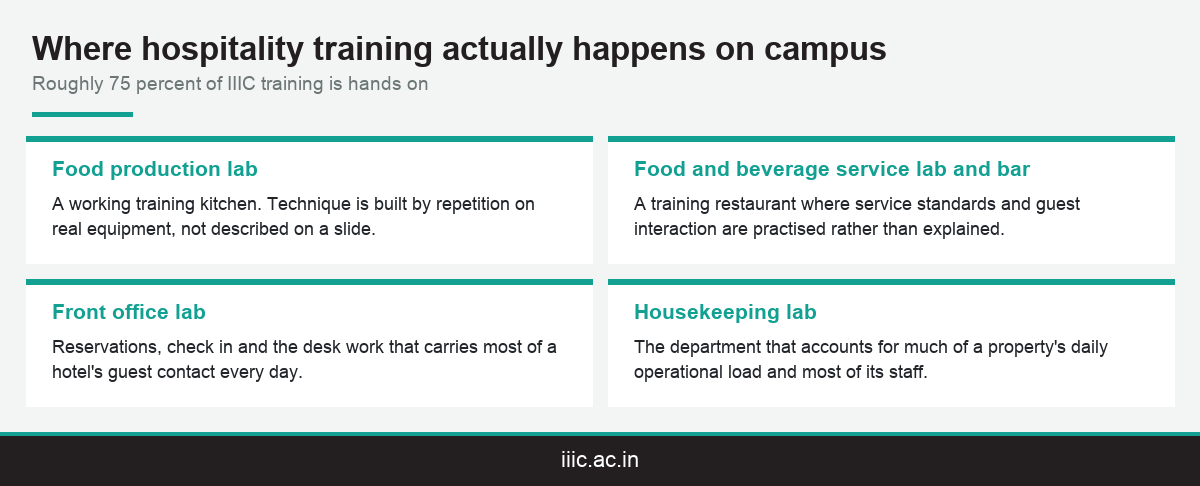
On the kitchen side, IIIC runs the food production lab as a working training kitchen. Technique is built by repetition on real equipment, and there is no classroom substitute for it.
On the service side, the food and beverage service lab provides a training restaurant and bar, which is where service standards and guest interaction are actually practised rather than described.
Rooms division has its own facilities. The front office lab and the housekeeping lab cover the two departments that account for most of a hotel’s daily operational load.
IIIC puts the hands on share of its training at roughly seventy five percent across the institute, and in hospitality that proportion is the whole argument for a campus programme over a theory course.
Food safety runs through all of it. Standards set by bodies such as the Food Safety and Standards Authority of India are not optional extras in a commercial kitchen, and a programme that treats them as a module rather than a habit is teaching the wrong thing.
A campus visit answers more than any brochure. Walk through the kitchen, look at the equipment and ask how many students work a station at once, since that ratio determines how much technique anybody actually builds.
The residential campus matters here for a reason specific to this field. Hospitality operates outside office hours, and training that includes evening service in a working restaurant is far easier to run when students live on site than when everybody has to travel home afterwards.
The supporting facilities are part of that picture too. The Kollam campus provides hostel accommodation, a cafeteria, a central library and a counselling cell alongside the technical training spaces, which is what makes a residential programme workable over six months or a year.
Where Kerala Graduates Actually Get Hired
Hospitality employment in Kerala is broader than the tourism headline suggests, and understanding that breadth changes how you read a placement list.
Tourism properties are the visible part: backwater resorts, hill station hotels, heritage properties and the seasonal operations that surround them, all with distinct staffing patterns through the year.
Business and city hotels are the steadier part, with year round occupancy driven by commercial travel rather than season, which tends to suit people who prefer a predictable operating rhythm.
Institutional catering is the part almost nobody mentions and a significant employer of trained kitchen staff: hospitals, campuses, corporate canteens and contract catering operations that run every day of the year.
That last category is worth taking seriously if stability matters to you. Contract catering runs to fixed hours and fixed volumes far more often than restaurant work does, and it employs a steady number of trained kitchen staff without the seasonal swings the tourism side carries.
IIIC names Club Mahindra and Le Meridien among more than fifty recruiting organisations across its programmes on the placement outcomes page. Check which of them hire into hospitality specifically rather than assuming the whole list applies.
The overseas route is real but should be understood properly. Kerala professionals have long worked in Gulf hospitality, and a recognised credential is easier to explain to an overseas employer than an unaccredited one, though no institute can promise a posting.
Tourism policy context is worth a look if you are weighing the sector as a whole. India’s tourism ministry publishes the sector data that underlies most hiring forecasts you will see quoted by training providers.
Treat those forecasts carefully whoever quotes them. Sector growth figures describe an industry, not a job offer, and the useful question for an applicant is which named employers hired from the specific programme they are considering during the last intake cycle.
One further route deserves mention. Hospitality has an unusually high rate of people starting their own operations, from small restaurants to catering businesses, and both IIIC routes give a grounding that makes that step less risky than entering it with no formal training at all.
What Accreditation Means in a Hospitality Context
Accreditation questions get asked less often in hospitality than in engineering disciplines, which is a mistake, because the training market here contains an even wider spread of quality.
IIIC is affiliated with the National Skill Development Corporation across thirteen sectors, not construction alone, which is what makes its hospitality and culinary programmes part of the same recognised structure as its technical ones.
It operates as a Centre of Excellence under the Kerala Academy for Skills Excellence and is managed in partnership with ULCCS, a worker cooperative active in Kerala infrastructure since 1925. It is also the only Training of Trainers centre in the state.
The full record sits on IIIC’s accreditation and affiliation page. Ask any provider you are comparing for the equivalent, and confirm it with the issuing body rather than accepting a logo on a page.
The practical benefit is portability. A qualification mapped to a recognised national framework is easier to explain to an employer in another state or another country, which matters in an industry where people move frequently.
It also affects how a first employer reads your application. A structured credential signals that somebody has already verified your food safety grounding and basic technique, which shortens the trial period most kitchens and front offices apply.
None of this replaces the facilities check. Accreditation tells you the qualification is recognised; the kitchen tells you whether you will actually learn to cook in it.
Ask one further question of any provider. Does the affiliation cover the specific programme you are applying to, or only the institute. Providers commonly run accredited programmes alongside unaccredited short courses, and the distinction is not always obvious from the marketing.
How to Decide, and What to Do Next
Reduce the decision to three questions and it usually resolves quickly, without needing to compare curricula line by line.
First, what qualification do you hold today. That single answer opens or closes the postgraduate tier and settles the matter for a large share of applicants before anything else is considered.
Second, do you want to make the product or run the operation. Both are respectable ambitions, and people are usually clearer about this than they expect once the question is asked directly rather than in career language.
Third, how soon do you need to be earning. The technician route is materially faster to a paid role, and for many applicants that consideration outweighs the longer term ceiling of the management route.
Once you have those three answers, the practical steps are the same for both routes. Applications run through an online form, the ATEiiic entrance assessment, a group discussion and then a personal interview.
Current intake dates sit on the admissions page. Seats are capped at forty per programme at the upper tiers and thirty at technician level, so popular programmes can close before a published deadline.
If you are still uncertain after all three questions, visit. An hour in the training kitchen and an hour in the front office lab tends to settle the matter faster than any amount of further reading, including this page.
Talk to somebody doing the job as well. A commis chef two years in and a duty manager two years in will describe their weeks very differently, and hearing both accounts is the closest you can get to trying each route before you commit to one of them.
Conclusion
The choice behind a post graduate hospitality management kerala search is usually a choice between two careers rather than two courses. IIIC runs a one year postgraduate programme for people who want to run hospitality operations, and a technician level food production certificate for people who want to cook professionally, both on the same residential Kollam campus with dedicated kitchen, service, front office and housekeeping facilities. Check your eligibility, decide whether you want to make the product or run the operation, then read the relevant programme page. Call 8078980000 or apply online at iiic.ac.in.
Frequently Asked Questions
What post graduate hospitality management in Kerala does IIIC offer?
IIIC runs a one year postgraduate hospitality management programme in its managerial tier, capped at forty seats. It covers rooms, food and beverage, front office and housekeeping operations plus the revenue and cost literacy a manager is measured on.
Is hotel management the same as a culinary qualification?
No. Management training prepares you to run an operation across departments. A culinary certificate prepares you to work in a kitchen brigade. They are related industries and genuinely separate careers with different entry points and progression ladders.
What qualification do I need for the postgraduate route?
The managerial tier generally expects a degree level qualification at entry. School leavers drawn to hospitality should look at the technician tier instead, and can return to the postgraduate route later once they hold a qualifying degree.
Can I train as a chef straight after school?
Yes. The food production certificate sits at IIIC’s technician tier, which accepts a school leaving qualification and has thirty seats per programme. It is the fastest route the institute offers into paid professional kitchen work.
What practical facilities does IIIC have for hospitality?
The Kollam campus runs a training kitchen, a food and beverage service lab with a bar, a front office lab and a housekeeping lab. Roughly seventy five percent of training across the institute is hands on rather than classroom based.
Who recruits hospitality graduates from IIIC?
IIIC names Club Mahindra and Le Meridien among more than fifty recruiting organisations across its programmes. It is worth asking the admissions team which of them hired into hospitality specifically during the most recent intake cycle.
Does tourism seasonality affect hospitality jobs in Kerala?
It affects resort and heritage properties more than city hotels, which run on commercial travel year round. Institutional catering in hospitals, campuses and corporate operations is steadier again and employs a large number of trained kitchen staff.
Is the qualification recognised outside Kerala?
IIIC is affiliated with India’s apex skill development body across thirteen sectors, which gives a credential mapped to a national framework. That portability helps when applying in other states, though no institute can promise an overseas posting.
How do I apply and how long does it take?
Applications run through an online form, the ATEiiic entrance assessment, a group discussion and then a personal interview. The sequence usually takes several weeks, and seats are capped per programme so early application is safer.
Can I visit the training kitchen before deciding?
Yes, and it is the most useful step available. An hour in the kitchen and an hour in the front office lab settles most doubts. Arrange it through the enquiry form before committing to an intake cycle.