

PGP in Interior Design and Construction at IIIC: Guide
You are kindly requested to fill out this form and select the course at IIIC that interests you so that we may get in touch with you as soon as admissions are open.
IIIC already has general interior design guides covering the field broadly. This page goes deeper on one specific program: the pgp interior design and construction postgraduate diploma, a 12 month course built for Civil Engineering graduates who want interior design capability integrated with real construction knowledge, not design taught as a purely aesthetic subject.
This is a program specific deep dive, pulled directly from IIIC’s official program page, covering exact fees, eligibility, curriculum areas, and the internship structure, for readers who have already decided the PGP tier is right for them or want the specific detail before deciding.
Key Takeaways
- The program runs 12 months, requires a B.Tech or BE in Civil Engineering specifically, and costs Rs 1,75,800.
- Curriculum spans design fundamentals, construction management and building codes, interior design software, and project management, not design skills alone.
- A mandatory 3 month internship places students at established architecture and interior design firms for hands on experience.
Program Basics: Duration, Fees and Eligibility
The Postgraduate Diploma in Interior Design and Construction runs 12 months and sits at IIIC’s Managerial program level. Eligibility is specific: a B.Tech or BE degree in Civil Engineering. This is narrower than some of IIIC’s other Managerial tier programs, which accept either Civil Engineering or Architecture graduates, so it is worth confirming this exact eligibility line before assuming you qualify based on a related IIIC program.
The course fee is Rs 1,75,800 for the full 12 month program. As of this writing, the program is listed as upcoming on IIIC’s official page, so confirm current intake status directly with the admissions team alongside checking the fee, since both can be updated as a new cohort approaches.
Because eligibility here is narrower than some other Managerial tier programs at IIIC, it is worth double checking before you plan around this specific course. A Civil Engineering graduate is a clear fit. An Architecture graduate interested in the same design-and-construction integration should confirm directly with IIIC whether an equivalent pathway exists, rather than assuming this program’s eligibility line applies to them by default.
What the Curriculum Actually Covers
The program description frames it as bridging academic design theory with industry practice, and the subject list backs that up. Design fundamentals and materials and product selection sit alongside space planning and layout optimization, color theory, and lighting and ventilation, the core aesthetic and technical design skill set.
Where this program earns its “and Construction” name is the second half of the curriculum: construction management and methods, building codes and regulations, and project management sit alongside the design content, not as an afterthought. Sustainable design practices, a human centered design approach, ergonomics and product design, and interior design services and retrofitting round out the subject list, along with illustration and drawing technique and interior design software tools for producing professional design documentation.
This breadth is precisely the point of the program, and precisely why it demands an engineering degree at entry. A designer without construction training can specify a beautiful finish that turns out to be structurally or budget infeasible. A graduate who has been through building codes, construction methods, and project management alongside the design curriculum is trained to catch that kind of conflict before it reaches a job site, which is the core value proposition of combining these two disciplines in one credential rather than treating them as entirely separate specializations.
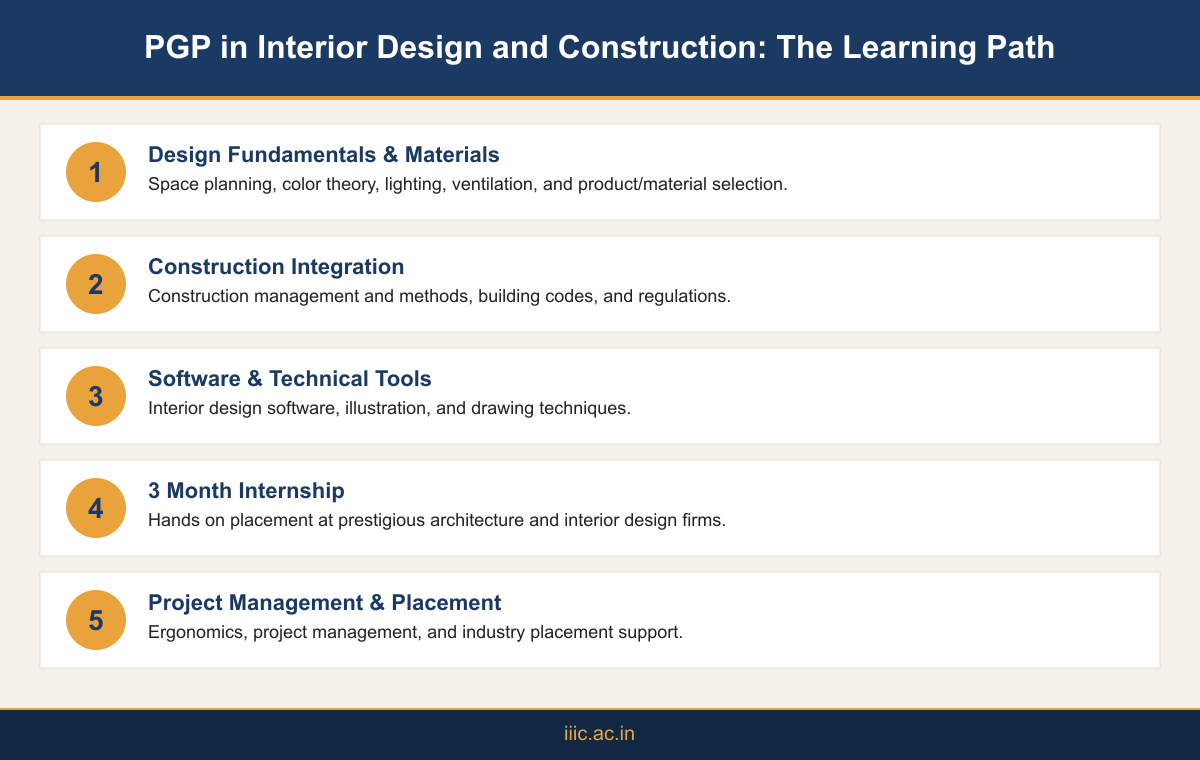
The subject areas covered across IIIC’s PGP in Interior Design and Construction
The 3 Month Internship at Design and Architecture Firms
A mandatory 3 month structured internship is built into the program, placing students at what IIIC describes as prestigious architecture and interior design firms for hands on experience. This mirrors the pattern across IIIC’s other Managerial and specialist programs, where a built in internship, not a self arranged one, is treated as a core part of training rather than an optional extra.
For a design and construction focused program specifically, this internship period is where the classroom integration of design and construction knowledge gets tested against a live project, working alongside professionals who are simultaneously managing design intent and construction reality on real client work.
A 3 month internship at this stage of a program also often functions as an extended interview. Firms hosting interns from a structured, engineering-plus-design program like this one are frequently evaluating candidates for a permanent offer at the end of the placement, which is worth keeping in mind when treating the internship as more than just a curriculum requirement to complete.
Faculty and Program Support
IIIC lists 30 plus faculty members supporting this program area, spanning professors, adhoc faculty, and industry experts across design, construction, and technical specializations. A mixed faculty model like this, academic staff alongside practicing industry experts, is generally a good sign for a program that explicitly positions itself at the intersection of two disciplines, since it suggests genuine input from both the design education side and the working construction side, not just one or the other.
Industry experts on faculty also matter specifically for a construction integrated design program, since building codes, material feasibility, and project management practices shift over time in ways a purely academic curriculum can lag behind. Practicing professionals contributing to teaching helps keep that portion of the curriculum current against what firms are actually doing on live projects right now.
Career Trajectory and Market Context
IIIC cites the Indian interior design market as expected to reach 2.1 billion dollars by 2025, with an anticipated 18 percent compound annual growth rate through 2029. Whatever the precise figures turn out to be, the underlying trend, rising demand for professionally trained interior design and design-construction talent in India, lines up with why a program combining both disciplines is a reasonable bet for a Civil Engineering graduate choosing a specialization.
IIIC does not publish a program specific placement percentage for this course separately, but its institute wide placement record shows program level rates from 92 to 100 percent across reported programs, evidence of the kind of employer relationships that support placement generally across the institute. For general interior design curriculum context beyond this specific PGP program, see Interior Design Courses in Kerala: Complete Guide 2026.
Is This Program Right for You
This program fits a specific profile well: a Civil Engineering graduate who wants to move into interior design without abandoning construction knowledge, aiming for roles that coordinate design intent with build reality rather than pure design execution roles. If you hold an Architecture degree instead of Civil Engineering, or want a shorter, more design focused route, it is worth checking IIIC’s Advanced Diploma in Interior Design eligibility separately, since this specific PGP’s entry requirement is Civil Engineering specifically.
Check current intake status, fees, and eligibility directly on the admissions page, and review the residential facilities available if you are relocating to Kollam for the 12 month duration.
If you are still unsure whether this program or a shorter, purely design focused alternative is the better fit, it is reasonable to contact IIIC’s admissions team directly with your specific degree and career goals and ask for guidance, rather than guessing based on program names alone.
Conclusion
IIIC’s PGP in Interior Design and Construction is a specific, 12 month, Rs 1,75,800 program for Civil Engineering graduates who want interior design integrated with real construction and project management knowledge, backed by a mandatory 3 month internship at design and architecture firms. It is a narrower fit than a general interior design course, by design, aimed squarely at graduates who want to work at the intersection of design and build. Confirm current intake status and eligibility directly with IIIC before applying.
Frequently Asked Questions
How long is the PGP in Interior Design and Construction?
The program runs 12 months and sits at IIIC’s Managerial program level, the same tier as programs like Advanced Construction Management.
What is the eligibility for this specific program?
A B.Tech or BE degree in Civil Engineering is required. This program does not list Architecture as an alternate eligible degree, unlike some other IIIC Managerial programs.
How much does the program cost?
The listed course fee is Rs 1,75,800 for the full 12 month program. Confirm current fees directly with IIIC before applying, since they can change between cohorts.
Does this program include an internship?
Yes, a mandatory 3 month structured internship at architecture and interior design firms is built into the curriculum.
What subjects are covered in the curriculum?
Design fundamentals, materials, space planning, color theory, lighting, construction management, building codes, sustainable design, ergonomics, interior design software, and project management.
How is this different from IIIC’s Advanced Diploma in Interior Design?
This PGP integrates interior design with construction management and requires a Civil Engineering degree, while the Advanced Diploma is a shorter, more design execution focused program with broader eligibility.
Is the program currently accepting applications?
The program was listed as upcoming as of this writing. Confirm current intake status directly with IIIC’s admissions team before planning around a specific date.
What career roles does this program lead to?
Graduates are positioned for roles coordinating design decisions with construction delivery, such as design-and-build coordination at construction firms, developers, or hospitality groups.
How many faculty support this program?
IIIC lists 30 plus faculty members across professors, adhoc faculty, and industry experts spanning design, construction, and technical specializations.
Where can I check current admission details?
Visit the admissions page directly for current eligibility, fees, and intake dates.