

Interior Design Courses in Kerala: Complete Guide 2026
You are kindly requested to fill out this form and select the course at IIIC that interests you so that we may get in touch with you as soon as admissions are open.
Kerala is rapidly emerging as a destination for quality interior design education. If you are considering an interior design course in Kerala, this guide covers everything from program types and fees to eligibility and career prospects. The Indian interior design market is valued at USD 22.21 billion and is growing at an 18% annual rate, creating strong demand for trained professionals across residential, commercial, and hospitality sectors. Choosing the right course is the first and most important step toward a rewarding design career.
Key Takeaways
- Interior design courses in Kerala range from 6-month diplomas to 12-month postgraduate programs.
- Course fees range from INR 75,600 to INR 1,75,800 depending on the program level and duration.
- Starting salaries for interior design graduates in Kerala range from INR 3 LPA to INR 4.5 LPA, growing to INR 8.5 LPA with experience.
Why Kerala Is Becoming a Hub for Interior Design Education
Kerala’s construction sector has seen consistent growth driven by NRI investment in residential properties, a thriving hospitality industry, and large-scale infrastructure projects funded through the Kerala Infrastructure Investment Fund Board (KIIFB). This construction boom is directly increasing demand for interior designers who understand both aesthetics and structural principles.
Interior design professionals in Kerala are increasingly required to work alongside civil engineers, making programs that integrate design with construction particularly valuable. Programs designed around RICS (Royal Institution of Chartered Surveyors) competency pathways give Kerala graduates a measurable advantage in both domestic hiring and Gulf employment markets, where structured qualifications are highly valued. Kerala also benefits from a strong culture of government-backed skill development aligned with national bodies such as NSDC.
The state’s residential real estate sector continues to attract NRI demand, particularly in Thiruvananthapuram, Kochi, Kozhikode, and Thrissur. Interior designers who can handle client briefs across premium residential and hospitality typologies are in particularly high demand, making structured postgraduate programs a worthwhile investment for civil engineering graduates.
Types of Interior Design Courses Available in Kerala
Interior design education in Kerala spans multiple levels and formats, catering to fresh graduates, working professionals, and experienced engineers looking to transition into design roles. Understanding the differences helps you choose a program that matches your background and career ambitions.
At the postgraduate level, the PGP IDC program at IIIC is a 12-month managerial-level program designed for B.Tech and BE Civil Engineering graduates. The curriculum covers design fundamentals, space planning, materials and products, interior design software, sustainable design, color theory, lighting, construction management, and project delivery. Students complete a three-month internship with leading architecture and design firms. Course fee: INR 1,75,800.
At the supervisory level, the Advanced Diploma in Interior Design (AD ID) is a 6-month program for diploma or degree holders in civil engineering with at least three years of field experience. It focuses on mood board creation, 3D rendering, on-site design supervision, project planning, and material selection. Course fee: INR 75,600.
Beyond these construction-aligned programs, Kerala’s interior design options include BSc programs (3 years), undergraduate design degrees (4 years at NIT Calicut), and short-term certificate courses (3 to 6 months). If you have a civil engineering background, a construction-specific program provides a stronger foundation for project-level design roles.
PGP IDC vs AD ID at a Glance
| Feature | PGP IDC | AD ID |
|---|---|---|
| Duration | 12 months | 6 months |
| Eligibility | B.Tech / BE Civil Engineering | Diploma/B.Tech Civil + 3 yrs exp |
| Fee | INR 1,75,800 | INR 75,600 |
| Level | Managerial | Supervisory |
| Focus | Design + Construction Management | On-site supervision + Design |
| Internship | 3 months structured | Included |
Interior Design Course Fees in Kerala: What to Expect
Interior design course fees in Kerala vary widely depending on institution type, program level, and duration. Understanding what you are paying for helps you evaluate whether a course represents good value.
At IIIC, the PGP IDC program is priced at INR 1,75,800 for 12 months, covering the full curriculum, structured internship coordination, and placement support. The AD ID is INR 75,600 for 6 months. Both programs deliver industry-connected learning with faculty drawn from active construction and design practices. You can view all available programs at IIIC to compare options across construction, design, and infrastructure disciplines.
Across Kerala more broadly, interior design course fees range from INR 50,000 to INR 1,50,000 per year for diploma programs at private institutes. BSc Interior Design programs at affiliated colleges typically cost INR 60,000 to INR 80,000 per year. When comparing fees, factor in the internship structure, placement support, faculty quality, and industry recognition of the qualification. A higher fee at an industry-aligned institution with strong placement records is often a better long-term investment than a lower-fee generic program without placement infrastructure.
Career Scope and Salary After an Interior Design Course in Kerala
The career outlook for interior design graduates in Kerala is strong and improving. The India interior design market is growing at 18% annually and is projected to expand significantly by 2029, driven by urbanization, NRI residential investment, and Kerala’s expanding hospitality and commercial construction sectors.
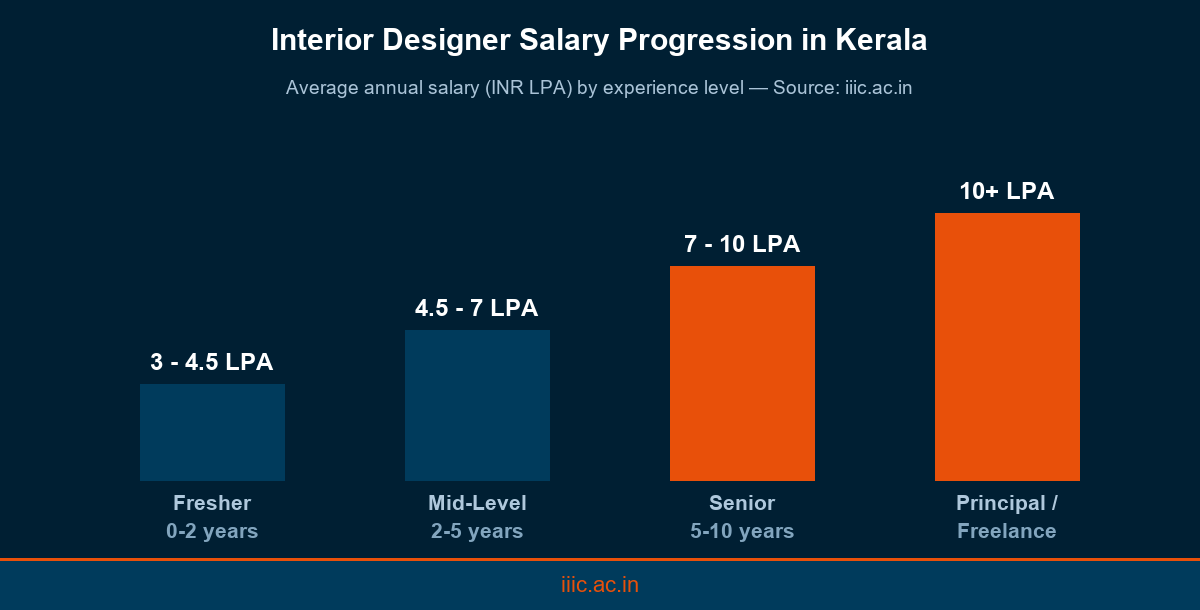
Starting salaries for interior design graduates in Kerala range from INR 3 LPA to INR 4.5 LPA. With three to five years of experience, salaries typically rise to INR 6 LPA to INR 8.5 LPA. Senior designers working on high-value residential and hospitality projects can earn INR 10 LPA or more, particularly those with Gulf project exposure. Common job roles include interior designer, space planner, furniture designer, 3D visualization artist, design project manager, and design consultant.
Freelancing is a popular route for experienced interior design professionals in Kerala, particularly for NRI residential projects. Freelance designers often earn above salaried benchmarks once they build a consistent client base, with project earnings that scale with portfolio quality and client network.
How to Choose the Best Interior Design Course in Kerala
Choosing the best interior design course in Kerala depends on three factors: your existing qualification, the career level you are targeting, and the credibility of the institution.
If you hold a B.Tech or BE in Civil Engineering and want a managerial role in interior design, the PGP IDC at IIIC is the most aligned choice. It builds on your engineering foundation and adds design, construction management, and RICS-aligned competencies recognized by international employers, particularly in the Gulf. If you are a working professional with a civil diploma and at least three years of experience, the AD ID offers a faster route into supervisory design roles without a full 12-month commitment.
Beyond qualification fit, evaluate institutions on three criteria: industry partnerships (do faculty come from active design practices?), internship quality (is it structured or self-arranged?), and placement support (what is the track record?). RICS-alignment is a strong quality indicator for interior design programs with a construction focus in Kerala. Programs backed by government bodies such as KASE and NSDC add further credibility in a competitive market.
Interior design education in Kerala has matured significantly, with structured programs available at multiple career levels. Whether you are a fresh Civil Engineering graduate or an experienced site professional looking to specialize in design, there is a program matched to your background and goals. Focus on programs that combine design fundamentals with construction knowledge, include a genuine internship component, and provide industry-connected placement support. Explore the interior design programs at IIIC to find the program that fits your profile and take the first step toward a rewarding career in one of India’s fastest-growing design markets.
Frequently Asked Questions
Q1. What is the eligibility for an interior design course in Kerala?
Eligibility varies by program level. Postgraduate programs like PGP IDC require a B.Tech or BE in Civil Engineering. Diploma programs typically accept graduates or diploma holders in civil engineering with relevant work experience.
Q2. What are the fees for interior design courses in Kerala?
Interior design course fees in Kerala range from INR 75,600 for a 6-month diploma to INR 1,75,800 for a 12-month postgraduate program. Government-aided colleges often charge lower fees, while industry-aligned institutes charge more for structured placements.
Q3. How long is a typical interior design course in Kerala?
Duration ranges from 6 months for advanced diploma programs to 12 months for postgraduate programs. Some undergraduate degrees in interior design take 3 to 4 years and are offered at design institutes and affiliated engineering colleges.
Q4. What is the salary after an interior design course in Kerala?
Starting salaries range from INR 3 LPA to INR 4.5 LPA for freshers. With 3 to 5 years of experience, earnings typically reach INR 6 LPA to INR 8.5 LPA. Senior designers and freelancers with Gulf project exposure can earn above INR 10 LPA.
Q5. Which is the best interior design course in Kerala for Civil Engineering graduates?
For Civil Engineering graduates, the PGP IDC at IIIC is a strong choice. It combines design fundamentals with construction management and is aligned with RICS competency pathways, making it valuable for both domestic and Gulf employment.
Q6. Can I do an interior design course after a Civil diploma?
Yes. The Advanced Diploma in Interior Design (AD ID) at IIIC accepts B.Tech or Diploma holders in Civil Engineering with at least 3 years of experience. It is a focused 6-month program covering design, space planning, 3D rendering, and on-site supervision.
Q7. Is interior design a good career in Kerala?
Yes, interior design is a strong career in Kerala. The state’s booming construction and hospitality sector creates consistent demand for trained designers. India’s interior design market is growing at 18% annually, offering strong long-term employment prospects.
Q8. Does IIIC offer interior design courses?
Yes. IIIC offers the PGP IDC (12 months, INR 1,75,800) for B.Tech Civil graduates and the AD ID (6 months, INR 75,600) for diploma or degree holders with experience. Both include structured internships and placement support. For more insights, visit the IIIC blog.
Q9. What software is taught in interior design courses?
Most interior design programs in Kerala cover AutoCAD, SketchUp, 3D rendering tools, and BIM software. Construction-aligned programs also include project planning tools integrated with design fundamentals, space planning, and material specification modules.
Q10. What job roles can I get after an interior design course in Kerala?
Graduates can work as interior designers, space planners, design project managers, furniture designers, 3D visualization artists, or design consultants. Construction-focused programs also qualify graduates for on-site design supervision and architectural coordination roles.