

Interior Design at IIIC: Advanced Diploma vs PGP
You are kindly requested to fill out this form and select the course at IIIC that interests you so that we may get in touch with you as soon as admissions are open.
If you are searching for the best interior design course in kerala, IIIC actually offers two distinct paths, not one, and picking the wrong one can cost you months of misaligned training. This page is a decision hub built specifically to help you choose between the Advanced Diploma in Interior Design and the Postgraduate Diploma in Interior Design and Construction.
IIIC already publishes two general guides covering interior design fundamentals at the institute: Interior Design Course in Kerala: IIIC's Complete Guide and Interior Design Courses in Kerala: Complete Guide 2026. If you want broad curriculum detail, read those. This page instead focuses specifically on the decision between IIIC's two program levels, so you choose the one that actually matches your background.
The two programs are not different quality tiers of the same thing, they are built for genuinely different people and genuinely different job outcomes. Treating them as interchangeable, or assuming the longer, more advanced sounding program is automatically the better choice, is the single most common mistake prospective applicants make when comparing IIIC's interior design options.
Key Takeaways
- IIIC runs two interior design tracks: a 6 month Advanced Diploma for degree/diploma holders with experience, and a 1 year PGP that integrates design with construction management for engineering or architecture graduates.
- The Advanced Diploma trains focused design execution skills; the PGP trains design decisions alongside construction and project delivery knowledge.
- Both sit within IIIC's NSDC and CSDCI backed accreditation structure, on the same residential Kollam campus.
Why Interior Design Is a Growing Field in Kerala
Kerala's residential and hospitality construction activity has created steady demand for trained interior design professionals, both for new builds and renovation work. Growth in this space is not limited to metro cities either, mid sized towns across the state now regularly commission designed interiors for homes, offices, and hospitality projects, expanding the pool of employers looking for formally trained designers.
Broadly, interior design as a discipline blends aesthetic judgment with technical constraints such as space planning, materials, and building systems, which is exactly why a structured program tends to produce more job ready graduates than informal design experience alone.
Clients today also expect more from a designer than a mood board. They want someone who understands how a chosen material behaves over time in Kerala's humid climate, how a lighting plan interacts with electrical load, and how a design decision affects overall project cost and timeline. That expectation is exactly what separates a hobbyist design sensibility from a professionally trained one, and it is why formal training has become a genuine differentiator for anyone trying to build a serious career in the field rather than freelance informally.
There is also a Gulf dimension worth noting, consistent with the broader pattern across IIIC's programs. Kerala has a long standing pipeline of construction and design professionals working across UAE, Qatar, and Saudi Arabia, and interior design and fit out work is a meaningful part of that market, particularly in hospitality and retail. A credential from an NSDC and CSDCI affiliated institute travels better with overseas employers and recruitment agencies than an informal or purely local design background, for the same reason accreditation matters in any cross border hiring context.
IIIC's Two Interior Design Program Levels, at a Glance
IIIC offers interior design training at two distinct tiers rather than one generic course. The Advanced Diploma in Interior Design runs 6 months and generally requires a relevant bachelor's degree or diploma plus around 3 years of experience. The Postgraduate Diploma in Interior Design and Construction runs 1 year and generally requires a B.Tech or BE in Civil Engineering or Architecture.
The difference is not just duration. The Advanced Diploma sits within IIIC's specialist tier alongside programs like MEP and quantity surveying, aimed at deepening a specific practical skill set. The PGP sits within IIIC's Managerial tier alongside programs like Advanced Construction Management, aimed at producing professionals who can operate at a project leadership level, in this case leading design decisions that are integrated with construction delivery rather than treated as a separate discipline.
It helps to think of these two tiers as sitting on the same ladder used across IIIC's other program areas. Just as a Technician certificate feeds naturally into an Advanced Diploma with enough experience, and an Advanced Diploma specialist can later pursue further study toward PGP eligibility, IIIC's interior design tracks are built so a student is not permanently locked into one scope of work based on their first enrollment decision.
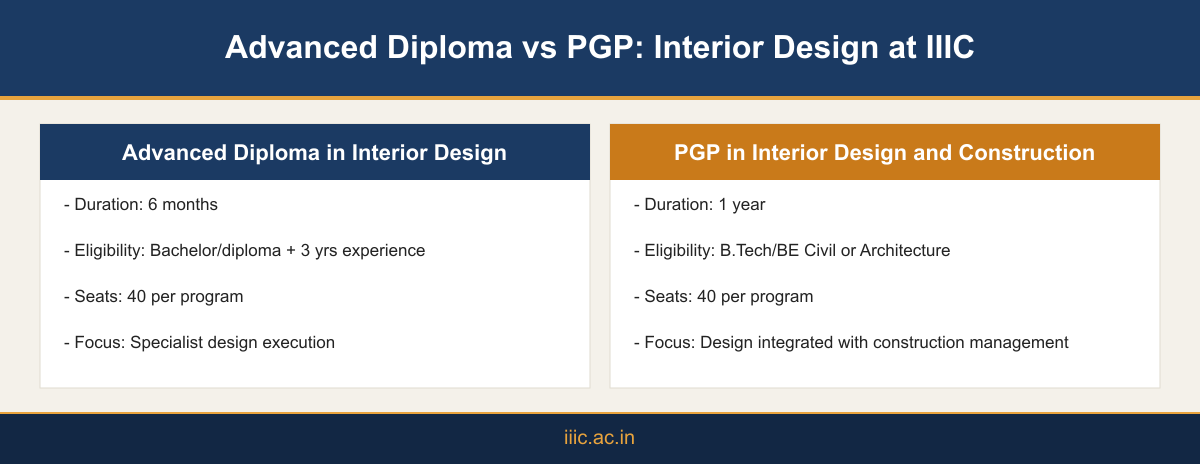
IIIC's two interior design program levels, compared
Advanced Diploma in Interior Design: Who It's For
The Advanced Diploma tier is built for people who already hold a relevant qualification and some work experience and want to formalize and deepen specific interior design skills within a focused 6 month window, rather than commit to a full year of broader training.
This format suits candidates who already know they want to work specifically as interior designers executing on space planning, material selection, and design documentation, rather than candidates who want to eventually manage the full construction process a design sits inside.
A typical Advanced Diploma candidate at IIIC has already spent a few years around design or architecture work, perhaps as a junior designer, a draftsperson, or in an adjacent trade, and wants a formal, recognized credential that validates and extends that experience rather than starting design education from zero. The 6 month format respects that existing base rather than repeating fundamentals a working professional has already picked up informally.
This also makes the Advanced Diploma a reasonable option for someone transitioning into interior design from a related creative or technical field, such as fine arts, architecture support roles, or furniture and carpentry trades, where the underlying spatial and material sense already exists but a formal, recognized design credential does not yet.
What the Advanced Diploma curriculum tends to emphasize
Programs at this level typically emphasize practical, execution focused skills: space planning, material and finish selection, lighting design fundamentals, furniture layout, and design documentation and presentation. The emphasis is on producing a designer who can take a brief and deliver a complete, buildable design, not necessarily manage the construction team executing it.
Documentation skill in particular is worth calling out, since it is frequently underestimated by newer designers. A design that looks strong as a rendering but cannot be clearly communicated to a contractor through proper drawings and specifications creates costly execution errors on site. IIIC's emphasis on documentation and presentation as a distinct curriculum area reflects exactly this real world failure point.
Typical outcomes after the Advanced Diploma
Graduates commonly move into roles at design studios, retail fit out companies, or as in house designers for developers and hospitality brands, generally reporting to a senior designer or studio lead early in their career before taking on independent client work. The 6 month timeline means a working professional can complete this credential without an extended career gap, which is part of why it appeals specifically to people already earning in an adjacent role.
PGP in Interior Design and Construction: Who It's For
The PGP tier is built for Civil Engineering or Architecture graduates who want interior design capability integrated with genuine construction and project management knowledge, rather than design skills alone. The "and Construction" naming is deliberate: this program treats interior design decisions as inseparable from structural, material, and delivery constraints, not as a purely aesthetic layer applied after construction is complete.
Graduates of this tier are positioned for roles that sit between design and delivery, coordinating with architects, contractors, and clients simultaneously, rather than roles that focus purely on design output. This is a meaningfully different career trajectory than the Advanced Diploma path, even though both involve interior design work day to day.
This program tends to attract two kinds of applicants: recent Civil Engineering or Architecture graduates who discovered an interest in interior work during their degree and want to specialize toward it directly, and working engineers or architects a few years into their career who keep finding interior coordination responsibilities landing on their desk without formal training to back it up.
If you fall into the second group, it is worth being candid about the gap the program is closing. Many engineers and architects pick up interior coordination knowledge informally on the job over several years, learning through mistakes on live projects. The PGP compresses that same learning curve into a structured year, which is often faster and less costly, in terms of project errors, than learning it entirely through trial and error on the job.
How this differs from the Advanced Diploma in practice
Where the Advanced Diploma trains you to design within a space, the PGP trains you to make decisions about how a space is built and finished simultaneously, including material feasibility, sequencing with other trades like MEP installation, and budget tradeoffs. This is a genuinely broader scope, which is why the entry bar requires a full engineering or architecture degree rather than a diploma plus experience.
A useful way to picture the difference: an Advanced Diploma graduate is typically the person a client or contractor brings in to design and specify a space. A PGP graduate is typically the person who sits in the project meeting deciding how that design fits into the broader construction schedule, budget, and technical constraints, then works with the design specialist to resolve conflicts before they become expensive site problems.
Typical outcomes after the PGP
Graduates commonly move into project coordinator or design-and-build roles at construction firms, real estate developers, or hospitality groups managing renovation and fit out projects, where their engineering or architecture background combined with design-construction integration training lets them bridge conversations between a design team and a site execution team that might otherwise talk past each other.
Career Outcomes and Placement Context
IIIC does not publish an interior design specific placement percentage separately, but its institute wide placement record shows program level rates from 92 to 100 percent across reported programs, with recruiting partners spanning construction, hospitality, and design adjacent firms, evidence of the kind of employer network that supports placement generally at the institute.
Beyond direct placement, both tracks feed into freelance and independent practice paths as well, which is common in interior design generally. An Advanced Diploma graduate with a strong portfolio often builds an independent residential design client base over a few years, while a PGP graduate with construction coordination experience is well positioned to eventually run their own design-build outfit rather than staying purely employee side. Neither program guarantees this outcome, but the underlying skill sets each builds toward it differently.
For interior design specifically, PGP graduates tend to be positioned for design-and-delivery coordination roles at construction firms, real estate developers, or hospitality groups, while Advanced Diploma graduates tend to move into design studio, retail interior, or residential design execution roles. Neither path is objectively higher paying, the roles are simply different in scope.
It is worth being direct about what these numbers do and do not tell you. A 92 to 100 percent range across the reported programs is a strong signal of an active, functioning placement office and genuine recruiter relationships, but it is an institute wide figure, not a program specific guarantee for interior design graduates in particular. Treat it as evidence that IIIC's placement infrastructure works, and confirm current interior design specific outcomes directly with the admissions or placement office before enrolling if that number is a deciding factor for you.
Recruiting partners named across IIIC's programs span construction majors like Reliance, Ultratech, Berger, and Sobha, technology and GIS firms like ESRI India, and hospitality names like Club Mahindra and Le Meridien. For interior design graduates specifically, the hospitality and real estate names in that list are the more directly relevant employer categories, since hotel groups and developers are consistent buyers of interior design and fit out talent.
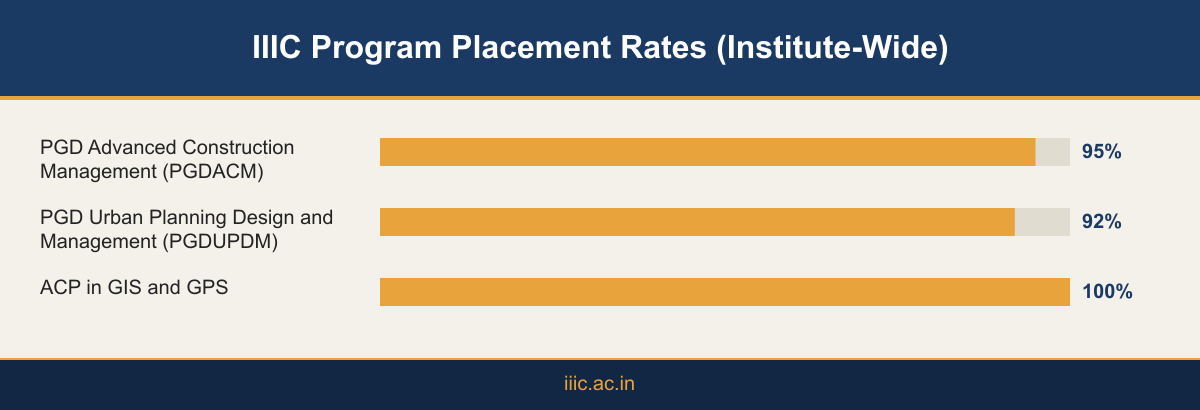
IIIC's reported placement rates across its programs, institute wide
Campus, Facilities and Resources for Design Students
Both interior design tracks are delivered from IIIC's 9.2 acre Kollam campus, which includes smart classrooms, digital and physical libraries, advanced labs, and a residential hostel for students relocating from elsewhere in Kerala. Full details are on the facilities page.
The counselling cell available on campus is also worth mentioning specifically for design students, since choosing between the depth of a focused Advanced Diploma and the breadth of a PGP is exactly the kind of decision academic counselling support is meant to help with, particularly for students weighing this choice against family expectations or financial constraints around a 6 month versus 1 year commitment.
For design students specifically, access to digital libraries and computer labs matters for design software and documentation work, while the residential hostel setup matters for students traveling from outside the immediate Kollam area, since design coursework often requires sustained studio time rather than commuting around a class schedule.
Design education in particular benefits from consistent access to shared workspace and equipment rather than working entirely from a personal laptop at home, since presentation boards, material samples, and drafting equipment are easier to manage on a dedicated campus. Students weighing IIIC against a purely online or hybrid interior design course should factor this hands on, on campus component into the comparison, since a large part of design skill develops through repeated in person critique and iteration rather than self study alone.
How to Choose Between the Two Tracks
Start with your existing qualification, since it is the hard constraint. If you do not hold a Civil Engineering or Architecture degree, the PGP tier is not available to you regardless of interest, which makes the Advanced Diploma the realistic near-term option if you already have relevant experience.
If you are eligible for both, the more useful question is what kind of work you want day to day. If you want to focus purely on design, materials, and aesthetics, choose the Advanced Diploma. If you want to sit at the intersection of design and construction delivery, coordinating multiple trades and stakeholders, choose the PGP.
Time and cost also factor in honestly. A 6 month program is a smaller commitment against current income if you are already working, while a 1 year program is a larger upfront investment that tends to pay off through a broader long term role ceiling. Neither factor should override eligibility or genuine interest, but both are legitimate parts of a real decision, not things to ignore in favor of an idealized answer.
It is also fine to treat this as a sequential decision rather than a one time choice. An Advanced Diploma graduate who later completes an engineering or architecture degree can pursue the PGP down the line if their ambitions shift toward project leadership.
A third, less obvious factor is how you personally prefer to work. Some designers are happiest going deep on the creative and material side of a project and would find the PGP's heavier construction management content a distraction from the work they actually enjoy. Others find pure design work unsatisfying without visibility into how their decisions play out on an actual construction timeline and budget. Being honest with yourself about which of these describes you is often more useful than only weighing eligibility and career ceiling.
Admissions Process Overview
Both tracks go through IIIC's standard admissions process: an online application, the ATEiiic entrance assessment, and a group discussion and interview stage before seats are confirmed. Both offer 40 seats per program.
IIIC's broader institutional backing, an NSDC and CSDCI affiliated Centre of Excellence under KASE, run in partnership with ULCCS, applies equally to both tracks. Full detail is on the accreditation and affiliation page. Since application windows change each cycle, confirm current eligibility and intake dates directly on the admissions page before applying.
Because seats are capped at 40 per program across both tracks, and interior design draws consistent applicant interest given the field's visibility, it is worth applying as soon as a window opens rather than waiting. Have your qualifying certificates ready ahead of time, whichever track you are applying to, since eligibility verification happens early in the process and delays here can push your application behind the intake cycle.
Conclusion
There is no single best interior design course in kerala answer independent of your background. IIIC's Advanced Diploma in Interior Design suits degree or diploma holders with experience who want focused design execution skills in 6 months. The PGP in Interior Design and Construction suits Civil Engineering or Architecture graduates who want design capability integrated with construction and delivery knowledge over 1 year. Both sit within the same NSDC and CSDCI backed institution on the same residential Kollam campus, so the decision genuinely comes down to your background and the kind of design career you want, not institutional quality. For the broader curriculum detail behind either track, read IIIC's complete interior design guides, then confirm current eligibility on the admissions page.
Frequently Asked Questions
What interior design programs does IIIC offer?
IIIC offers two tracks: a 6 month Advanced Diploma in Interior Design, and a 1 year Postgraduate Diploma in Interior Design and Construction.
What is the eligibility for the PGP interior design program?
The PGP in Interior Design and Construction generally requires a B.Tech or BE degree in Civil Engineering or Architecture.
Can I join the Advanced Diploma without an engineering degree?
Yes. The Advanced Diploma in Interior Design generally requires a relevant bachelor's degree or diploma plus around 3 years of work experience, not an engineering degree specifically.
What is the difference between the two interior design tracks?
The Advanced Diploma trains focused design execution skills over 6 months. The PGP integrates interior design with construction and project delivery knowledge over 1 year.
How many seats are available in each program?
Both the Advanced Diploma and the PGP in Interior Design and Construction offer 40 seats per program at IIIC.
What career roles follow each track?
Advanced Diploma graduates typically move into design studio or residential execution roles. PGP graduates typically move into design-and-delivery coordination roles at construction or development firms.
Does IIIC provide hostel facilities for design students?
Yes. IIIC's residential Kollam campus includes hostel facilities for students relocating from elsewhere in Kerala. See the facilities page for details.
Is IIIC accredited for its interior design programs?
Yes. Both tracks sit within IIIC's broader NSDC and CSDCI affiliated accreditation structure as a KASE Centre of Excellence.
Where can I read the full interior design curriculum details?
IIIC publishes dedicated complete guides covering curriculum detail, linked from this page, for readers who want depth beyond the program-choice comparison covered here.
How do I apply to an IIIC interior design program?
Both tracks go through IIIC's standard admissions process, including an entrance test and interview. Check the admissions page for current eligibility and dates.