

Construction Courses in Kerala: Which IIIC Program Fits You
You are kindly requested to fill out this form and select the course at IIIC that interests you so that we may get in touch with you as soon as admissions are open.
Searching for construction courses in kerala usually turns up dozens of scattered options with no clear sense of which one actually leads to a job. IIIC solves that differently. Instead of a single generic course, it runs a structured 3 tier ladder, from short technician certificates through 6 month advanced diplomas up to 1 year postgraduate programs, all built around real construction and infrastructure roles.
This guide is a decision hub, not a repeat of any single program page. If you already know you want the full detail on IIIC’s flagship postgraduate program, read the Construction Management Course in Kerala: Complete PGP Guide. If you are still deciding which tier fits your background and goals, this page walks through all three, with real placement numbers and a practical framework for choosing.
Kerala’s construction and infrastructure sector has been absorbing skilled talent steadily, driven by both domestic project activity and a long-standing pipeline of Kerala professionals working in Gulf construction markets. A credential that is recognized both by local employers and by the broader skill certification ecosystem carries more weight in that environment than a generic diploma with no external accreditation behind it, which is a large part of why the tier and accreditation details below are worth reading carefully before you enroll anywhere.
Key Takeaways
- IIIC runs three distinct entry points into construction careers: Technician (short-term, SSLC/Plus One), Advanced Diploma (6 months, degree/diploma plus experience), and PGP Managerial (1 year, B.Tech/BE Civil or Architecture).
- The institute is NSDC and CSDCI affiliated, backed by KASE and ULCCS, and is the only Training of Trainers center in Kerala.
- Verified placement rates run from 92 to 100 percent across reported programs, with recruiters including Reliance, Ultratech, Berger, and Sobha.
IIIC’s 3-Tier Construction Education Ladder, at a Glance
Most institutes offering construction courses in kerala run a single track: enroll, attend, graduate. IIIC instead structures its construction and infrastructure offerings as three distinct tiers, each aimed at a different starting point and a different career outcome, all delivered from its 9.2 acre campus on National Highway 66 in Kollam.
At the base is the Technician tier, a short-term, practical entry point for SSLC or Plus One holders who want to start working sooner rather than later. In the middle sits the Advanced Diploma tier, 6 month programs aimed at people who already have a bachelor’s degree or diploma plus some work experience and want a specialized, job-ready credential. At the top is the PGP Managerial tier, 1 year postgraduate programs for B.Tech or BE graduates in Civil Engineering or Architecture who want to move into supervisory and management roles rather than site-level execution.
Across all three tiers combined, IIIC runs 19 distinct programs, four at Technician level, eight as Advanced Diplomas, and seven at PGP Managerial level, spanning construction, MEP, interior design, GIS, hospitality, and urban planning. That breadth is what makes IIIC function as an infrastructure training institute kerala hub rather than a single-course provider, since a student’s eventual specialization decision can be made after understanding the full map of options, not just the first program they happen to come across.
None of these tiers are “better” in an absolute sense. They serve different people at different points in their education and career, and choosing correctly matters more than chasing the most advanced-sounding title.
It also helps to think of the three tiers as points on a single ladder rather than three unrelated products. A Technician graduate can return years later for an Advanced Diploma once they hold a qualifying degree and experience. An Advanced Diploma graduate working in a specialized role can later pursue a PGP program if they move toward Civil Engineering study and want to step into management. IIIC’s structure is deliberately built so that a student’s first enrollment does not have to be their last, which matters in a field like construction where careers commonly span decades and multiple role changes.
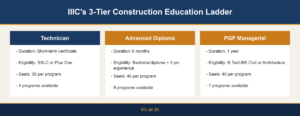
[Alt: Infographic comparing IIIC’s Technician, Advanced Diploma, and PGP Managerial construction program tiers] | IIIC’s three program tiers, compared by duration, eligibility, and seat count
Technician Level: The Fastest Way Into a Construction Career
The Technician tier is built for candidates with an SSLC or Plus One qualification who want to enter the construction workforce quickly, without first completing a degree. IIIC runs four short-term programs at this level, each with 30 seats, including the Construction Laboratory and Field Technician program alongside dedicated tracks for roles like assistant electrician, assistant plumber, and excavator operator.
This tier is genuinely job-oriented courses in kerala construction territory in the most literal sense: the training is built around specific, named site roles rather than broad theory. For someone who wants to start earning in a skilled trade role within months rather than years, this is usually the right starting point, and IIIC’s job oriented courses in kerala construction offerings tend to lead directly into site or field roles with recruiting partners.
What makes this tier different from picking up a trade informally on a job site is structure and safety grounding. Technician-level training covers not just the mechanical skill of a trade, whether that is operating an excavator or wiring an installation, but also the site safety protocols and equipment handling standards that employers increasingly expect as a baseline, not an extra. A candidate who has been through a structured technician program is generally faster to onboard on a real site because supervisors do not need to start from zero on safety and procedure.
This tier also functions as a practical stepping stone rather than a dead end. A Technician graduate who spends a few years gaining field experience and later completes a bachelor’s degree or diploma has a natural path back into IIIC at the Advanced Diploma tier, since the eligibility for that tier is built around exactly this combination of qualification plus experience.
Advanced Diploma Track: 6 Months, Built for Specialization
The Advanced Diploma tier sits between Technician and PGP levels, and it is where IIIC runs the largest number of distinct programs, eight in total, each with 40 seats. Eligibility generally requires a relevant bachelor’s degree or diploma plus around 3 years of work experience, which makes this tier a strong fit for working professionals looking to specialize or formalize skills they already use informally.
Programs at this level cover specialized construction-adjacent disciplines including MEP systems and facility management, quantity surveying and contracts management, quality assurance and quality control, environment health and safety management, GIS, BIM, and interior design. Two examples illustrate the range well.
The 6 month format matters as much as the subject matter. A working professional with 3 years of site or design experience usually cannot afford to step away for a full 1 or 2 year postgraduate program, both financially and in terms of career momentum. The Advanced Diploma format is built around that reality: a focused, single-discipline curriculum delivered in half a year, aimed at people who already understand the industry broadly and need a specific, named credential to move into a more senior or specialized role within it.
Example: Advanced Diploma tracks aimed at site delivery
Programs like Quality Assurance and Quality Control Management or Environment Health and Safety Management are built for people already working on or near construction sites who need a formal credential covering compliance, safety protocol, and quality inspection responsibilities that Indian construction employers increasingly require by name.
These site-delivery programs tend to suit candidates who have already spent time on active projects, whether as junior engineers, supervisors, or contractors, and who have felt the practical gap between informal on-the-job knowledge and what a formal audit, inspection, or safety compliance role actually demands on paper. Quantity Surveying and Contracts Management sits in a similar bracket, aimed at professionals who handle project costing, billing, and contractual documentation rather than physical execution.
Example: Advanced Diploma tracks aimed at technical specialization
Programs like BIM (Building Information Modeling) or GIS instead build a specific technical software and process skill set, useful for candidates who want to move toward digital construction planning and coordination roles rather than physical site supervision.
This category has grown in relevance as Indian infrastructure projects increasingly require digital documentation and coordination as a contractual requirement, not an optional add-on. A civil or architecture-adjacent graduate who adds a BIM or GIS Advanced Diploma to their existing degree is generally positioning for the specific project roles that combine domain knowledge with a software specialization, which tend to be harder to fill and correspondingly more in demand than either skill alone.
PGP Managerial Track: 1-Year Postgraduate Programs for Engineers
The PGP or Managerial tier is IIIC’s most advanced offering, seven 1 year postgraduate programs with 40 seats each, generally requiring a B.Tech or BE in Civil Engineering or Architecture to enroll. This is the pgp construction management layer aimed squarely at graduates who want to move into project management, delivery leadership, and supervisory roles rather than staying in a purely technical execution position.
Programs at this level span Advanced Construction Management, Road Construction Management, Digital Project Management, MEP Systems and Management, Interior Design and Construction, Hospitality Management, and Urban Planning and Management, giving Civil or Architecture graduates a genuine choice of specialization rather than one generic “construction management” label.
The distinction between this tier and the Advanced Diploma tier is not just duration, it is the type of role each is built to prepare a graduate for. Advanced Diploma programs train specialists who execute within a defined discipline, such as running quality control checks or managing MEP facility operations. PGP Managerial programs instead train people to sit above multiple disciplines at once, coordinating budgets, timelines, contractors, and cross-functional teams on a project, which is why the entry bar is a full engineering or architecture degree rather than a diploma plus experience.
Deep dive: Advanced Construction Management
The flagship program at this level is the Postgraduate Program in Advanced Construction Management, an advanced construction management course india option built for graduates who want the broadest possible management scope rather than a narrower specialization like MEP or road construction specifically. For the full curriculum breakdown, timeline, and detailed eligibility, see the dedicated Construction Management Course in Kerala: Complete PGP Guide.
A closely related option worth knowing about is the Postgraduate Diploma in Road Construction Management, for graduates specifically drawn to highway and road infrastructure delivery rather than general building construction. Kerala’s road and highway sector has its own distinct project types, funding structures, and regulatory bodies compared to building construction, so graduates who already know they want to work in that specific sub-industry are usually better served choosing this specialization directly rather than a general construction management program and hoping to specialize later on the job.
Both programs share the same PGP-level entry bar and 1 year format, and both lead toward genuine management and delivery-leadership roles rather than site-execution positions, the key difference is simply which slice of the infrastructure industry a graduate wants to lead projects within.
Why NSDC, CSDCI, KASE and ULCCS Backing Actually Matters
A credential is only as valuable as the trust an employer places in it, and this is where IIIC’s institutional backing does real work. IIIC operates as a Centre of Excellence under the Kerala Academy for Skills Excellence, in partnership with ULCCS, one of Asia’s largest and longest running worker cooperatives, active in Kerala infrastructure since 1925.
On the accreditation side, IIIC is affiliated with the National Skill Development Corporation, running NSQF aligned and non-aligned courses across 13 sectors, and is separately affiliated with the Construction Skill Development Council of India. It is also, notably, the only Training of Trainers center in Kerala, meaning it is certified to train the trainers who then teach at other institutions, not just students directly. Full detail is available on the accreditation and affiliation page. You can read more about ULCCS directly as well.
For infrastructure training institute kerala options generally, this combination of government-linked skill body affiliation plus a genuinely operating construction cooperative as an institutional partner is not common, and it is a reasonable signal of institutional stability for a multi-year education decision.
This backing also shows up in how programs are structured, not just in a logo on a brochure. NSQF alignment means a course’s learning outcomes are mapped against a standardized national framework of knowledge and skill levels, so an employer evaluating a candidate’s certificate has a reference point for what it actually represents, rather than having to take the institute’s word for it. CSDCI affiliation adds a construction-sector-specific layer of the same idea, since CSDCI operates as the recognized Sector Skill Council for construction under India’s National Council for Vocational Education and Training.
Real Placement Outcomes Across IIIC’s Programs
Institutional backing matters less than actual outcomes, and IIIC publishes program-level placement figures rather than a single vague institute-wide number. Reported rates include 95 percent for the Postgraduate Diploma in Advanced Construction Management, 92 percent for the Postgraduate Diploma in Urban Planning Design and Management, and 100 percent for the Advanced Certificate Program in GIS and GPS.
Recruiting partners named on IIIC’s placement record page include major names such as Reliance, Ultratech, Berger, and Sobha alongside firms like ESRI India, Club Mahindra, and Le Meridien, spanning construction majors, materials companies, GIS/technology firms, and hospitality groups depending on the specific program.
The variety of recruiters is worth paying attention to as much as the headline percentages. A placement record built on 50 plus organizations across construction, materials, technology, and hospitality sectors suggests a genuinely diversified hiring pipeline rather than dependence on one or two large employers who could change hiring plans in a given year. For a prospective student, that spread is a reasonable proxy for how portable an IIIC credential is likely to be across different employer types, not just within a single company’s hiring cycle.
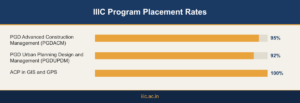
[Alt: Infographic showing IIIC placement rates of 95 percent, 92 percent, and 100 percent across three programs] | Reported placement rates for three IIIC programs
How to Choose Between the Three Tiers
The honest, practical filter is your current qualification plus your time horizon. If you hold an SSLC or Plus One and want to start earning within months, the Technician tier is the direct route, and there is no benefit to waiting for a degree first if a hands-on trade role is genuinely your goal.
If you already hold a bachelor’s degree or diploma and roughly 3 years of relevant experience, the Advanced Diploma tier lets you specialize into a named discipline like MEP, quantity surveying, or quality control within 6 months, which is usually faster and more targeted than a second full degree.
It helps to ask a second question alongside qualification: do you want to lead projects or execute within one. Someone who enjoys the technical depth of a single discipline, solving problems within quality control or facility management for instance, is often happier and more effective staying at the Advanced Diploma specialization level long term rather than moving up into a generalist management role purely because it sounds like career progress.
If you hold a B.Tech or BE in Civil Engineering or Architecture and want to move into management rather than staying purely technical, the PGP Managerial tier is built specifically for that transition, across seven distinct specialization areas.
One more factor worth weighing honestly is opportunity cost. A Technician program costs you months, an Advanced Diploma costs you roughly half a year, and a PGP program costs you a full year, on top of whatever qualification you already hold. If you are unsure which specialization within a tier fits you, it is generally better to spend more time confirming that choice before enrolling than to complete the wrong specialization and need to backtrack. IIIC’s admissions team can usually speak to program-fit questions directly if you are torn between two options at the same tier.
Admissions Process Overview
Across all three tiers, IIIC runs a structured admissions process rather than open, unassessed enrollment. Applicants submit an online application, take the ATEiiic entrance assessment, and then go through a group discussion and interview stage before seats are confirmed, with 40 seats per program at Advanced Diploma and PGP level, and 30 seats per program at Technician level.
The entrance assessment is administered by L&T EduTech and runs 75 minutes across 50 questions worth 100 marks in total, a format designed to be completed in a single sitting rather than spread across multiple test days. Candidates who clear the assessment threshold move to a group discussion, then a personal interview, before final seat offers go out per program.
Application windows and exact dates change from one intake cycle to the next, so the most reliable step is to check the live admissions page directly for current dates rather than relying on a specific date mentioned in any single article, including this one. Because seats are capped per program, at 40 or 30 depending on tier, popular specializations can fill before a stated deadline, so applying early in a given intake window is generally safer than waiting until the final days.
Conclusion
If you are comparing construction courses in kerala, the real decision is not which single course is “best” in the abstract, it is which of IIIC’s three tiers matches where you are starting from and where you want to end up. Technician level gets you working fastest, Advanced Diploma lets working professionals specialize in 6 months, and the PGP Managerial track turns Civil Engineering or Architecture graduates into project leaders. All three sit inside the same NSDC and CSDCI backed institution, on the same Kollam campus, with the same underlying placement infrastructure behind them, so moving between tiers later in your career remains realistic rather than theoretical. Whichever tier fits today, start by reviewing current eligibility and intake dates on IIIC’s admissions page and reach out with any specific program questions.
Frequently Asked Questions
- What construction courses does IIIC offer in Kerala?
IIIC offers construction and infrastructure programs across three tiers: short-term Technician certificates, 6 month Advanced Diploma programs, and 1 year PGP Managerial programs, covering areas from field trades to project management.
- What is the eligibility for the PGP construction management course?
IIIC’s PGP Managerial tier, including Advanced Construction Management, generally requires a B.Tech or BE degree in Civil Engineering or Architecture, with 40 seats available per program.
- How long does the Advanced Diploma track take to complete?
IIIC’s Advanced Diploma programs run for 6 months and typically require a relevant bachelor’s degree or diploma plus about 3 years of work experience to enroll.
- Can I join IIIC without a degree?
Yes. The Technician tier accepts SSLC or Plus One qualifications and is designed as a direct, faster entry point into skilled construction trade roles.
- What placement rates does IIIC report?
Reported program-level placement rates include 95 percent for Advanced Construction Management, 92 percent for Urban Planning Design and Management, and 100 percent for GIS and GPS.
- Is IIIC accredited or government recognized?
Yes. IIIC is NSDC and CSDCI affiliated, operates as a KASE Centre of Excellence in partnership with ULCCS, and is the only Training of Trainers center in Kerala.
- What companies recruit from IIIC?
Named recruiting partners include Reliance, Ultratech, Berger, Sobha, ESRI India, Club Mahindra, and Le Meridien, among 50 plus organizations across IIIC’s programs.
- How do I apply to an IIIC construction program?
Applications go through an online portal, an ATEiiic entrance assessment, and a group discussion and interview stage. Check the admissions process page for current intake dates.
- Where is IIIC located?
IIIC’s campus is 9.2 acres on National Highway 66 near Chavara Bridge in Neendakara, Kollam, Kerala, with a residential hostel for students relocating from elsewhere in the state.
- Does IIIC offer support beyond training?
Yes. Facilities include a residential hostel, libraries, labs, and a counselling cell, and the institute maintains an active placement office connecting students with recruiting partners. See facilities for details.