

PGP in Hospitality Management: Curriculum, Internships and Careers

You are kindly requested to fill out this form and select the course at IIIC that interests you so that we may get in touch with you as soon as admissions are open.
A hospitality management course kerala search usually turns up fee tables and little else about what the year actually contains. IIIC runs this programme at its postgraduate tier, which means it is built to produce somebody who can hold an operation to a standard across departments rather than perform any single one of them. This guide covers the scope, the practical component and where graduates go afterwards.
Key Takeaways
- The programme runs one year at IIIC’s managerial tier with forty seats, and the tier generally expects a degree level qualification at entry.
- The content is deliberately broad: rooms, food and beverage, front office and housekeeping, plus the revenue and cost literacy a manager is measured on.
- Practical exposure matters more than lecture hours, and IIIC runs dedicated kitchen, service, front office and housekeeping training facilities on campus.
- Kerala employers extend well beyond tourism into business hotels, hospitals and institutional catering, which changes how you should read any placement list.
Where This Programme Sits and Who It Is For
IIIC runs nineteen programmes across three tiers. A hospitality management course kerala applicants find here sits at the top tier, alongside advanced construction management, building services and interior design and construction.
One year is the format, capped at forty seats. Popular programmes can close before a published deadline, and the admission sequence itself runs from an online application through the ATEiiic assessment to a group discussion and an interview.
Current terms sit on the PGP HM programme page. Check eligibility and dates there rather than in any article, since programme pages are revised between intake cycles.
The applicant this suits is somebody who wants to run an operation. Not to cook, not to work one department indefinitely, but to be accountable for how several departments perform together against a standard and a budget.
That distinction is worth testing honestly before you apply. Management work in hospitality is scheduled, people heavy and increasingly analytical, and it is a genuinely different working life from the craft roles inside the same building.
If you have not yet settled the question of hotels against kitchens, IIIC publishes its comparison of the two hospitality routes, which addresses a closely related confusion between two labels applicants often treat as interchangeable.
For a broader read on the sector itself rather than this tier, IIIC’s hotels fees and careers guide covers the discipline at greater length and is the better starting point if the field is new to you.
One further point about the tier. A postgraduate year does not remove the need to spend time in departments once you are employed, and graduates who expect to walk straight into general management usually find the first year harder than those who plan for a supervisory step first.
That is not a criticism of the qualification. It is how the industry verifies people, and a graduate who has already worked evening service in a training restaurant tends to make that transition far more comfortably than one who has only studied the theory of it.
What the Curriculum Has to Cover
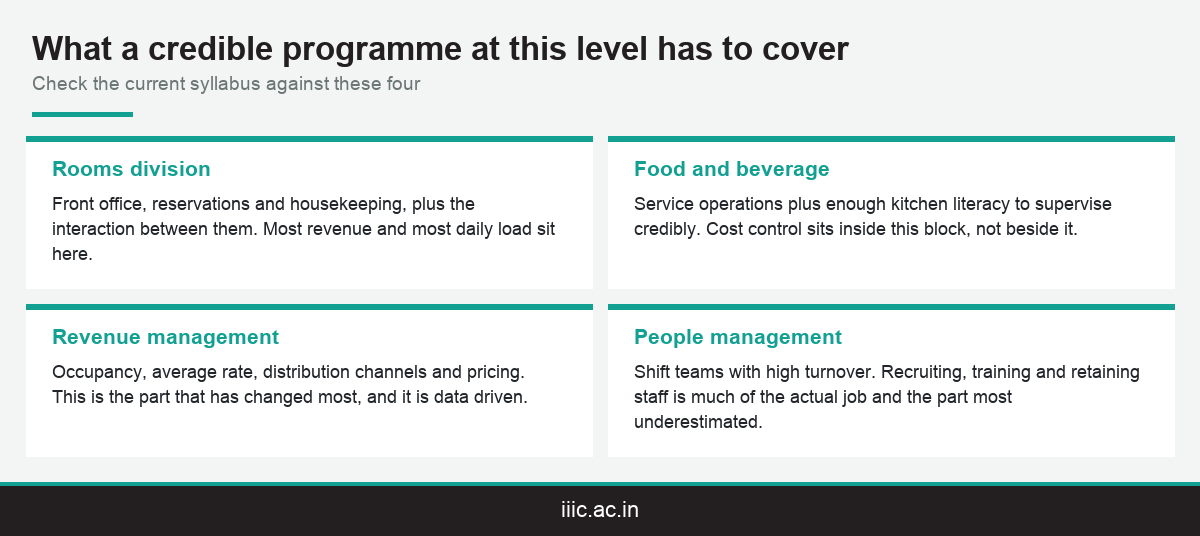
Rather than reproduce a module list that changes between cycles, it is more useful to set out what any credible programme at this level has to contain, so you can check the current syllabus against it when you read the programme page.
Rooms division comes first, because it is where most of a hotel’s revenue and most of its daily operational load sit. Front office, reservations, housekeeping and the interaction between them are the foundation.
Food and beverage is the second block, covering both service operations and enough kitchen literacy to supervise a kitchen credibly without pretending to run one. Cost control sits inside this block rather than beside it.
Revenue management is the third, and it is the part that has changed most. Occupancy, average rate, distribution channels and pricing decisions are now data driven, and comfort with those numbers is what separates a manager from a supervisor.
People management is the fourth, and the one applicants underestimate. Hospitality management as a field runs on shift teams with high turnover, and recruiting, training and retaining staff is much of the actual job.
Compliance runs through everything. Food safety standards set by bodies such as the Food Safety and Standards Authority of India are enforced rather than encouraged, and a manager carries responsibility for them whether or not they enjoy the paperwork.
When you compare programmes, ask how the syllabus is assessed. A programme assessed on real operational scenarios produces graduates who can make decisions under pressure; one assessed on written papers may not.
The Practical Component and Why It Decides Everything
Hospitality is learned by doing, and the honest measure of a programme is how much time students spend in operating environments rather than describing them. IIIC puts the hands on share of its training at roughly seventy five percent across the institute.
On the service side, the food and beverage service lab gives a training restaurant and bar. Service standards and guest interaction are practised there rather than explained on a slide.
Rooms division has its own facilities. The front office lab and the housekeeping lab cover the two departments a duty manager spends most of their time inside.
Kitchen literacy is built in the campus training kitchen. A manager does not need to cook to a professional standard, but they do need to understand what they are asking a kitchen to deliver and how long it takes.
The residential campus matters here for a practical reason specific to this field. Hospitality operates outside office hours, and evening service in a working training restaurant is far easier to run when students live on site.
Ask about industry exposure separately from campus facilities. Placement periods in operating properties are where students discover whether they enjoy the pace, and it is worth asking the admissions team how those are arranged.
A campus visit settles most of this in an afternoon. Look at the training restaurant and the kitchen, and ask how many students work a station at once, because that ratio determines how much anybody actually learns.
Careers, Employers and What Graduates Earn Their Place On
Hospitality employment in Kerala is broader than the tourism headline suggests, and that breadth is the most useful thing to understand before you read any placement list.
Tourism properties are the visible part: backwater resorts, hill station hotels and heritage properties, with staffing patterns that swing through the year in a way city hotels do not.
Business hotels are the steadier part, running on commercial travel rather than season. Institutional catering in hospitals, campuses and corporate operations is steadier again, and employs more trained staff than most applicants realise.
IIIC names Club Mahindra and Le Meridien among more than fifty recruiting organisations across its programmes on the placement outcomes page. Ask which of them hired into hospitality specifically during the last intake cycle.
Early roles are usually departmental before they are general. A graduate typically spends time as a duty manager or department supervisor before taking responsibility across an entire property, and that sequence is normal rather than a setback.
The overseas question comes up in most enquiries. Hospitality operations transfer across borders relatively cleanly, and a credential mapped to a recognised national skill body is easier to explain abroad, though no institute can promise a posting.
What graduates are ultimately judged on is not the qualification. It is whether they can hold a shift team together on a bad night, and the programmes that produce those people are the ones that put students in operating environments early.
Ask to speak to a graduate before you apply. One conversation about what their first six months in a property actually involved will tell you more about whether this route suits you than any curriculum comparison, and a confident institute will arrange it without hesitation.
Conclusion
A hospitality management course kerala applicants are weighing should be judged on two things: how broad the operational coverage is, and how much time students spend in real operating environments rather than classrooms. IIIC runs this programme at its one year postgraduate tier, with dedicated kitchen, service, front office and housekeeping facilities on a residential Kollam campus and a published recruiter list that reaches well beyond tourism. Read the programme page for current terms, or call 8078980000 to talk it through.
Related Reading
Frequently Asked Questions
What does the hospitality management course in Kerala at IIIC cover?
It covers rooms division, food and beverage, revenue management and people management across a one year postgraduate programme. The current module list sits on the programme page, since syllabuses are revised between intake cycles at every institute.
How long is the programme and how many seats are available?
It runs one year at IIIC’s managerial tier with intake capped at forty seats. Popular programmes can close before a published deadline, so applying early in an intake window is consistently safer than waiting for the closing date.
What qualification do I need to apply?
The managerial tier generally expects a degree level qualification at entry. School leavers drawn to the industry should look at the technician tier instead, and can return to this route later once they hold a qualifying degree.
Will I learn to cook on this programme?
You will build enough kitchen literacy to supervise a kitchen credibly, which is different from training as a chef. If cooking professionally is the goal, the food production certificate at technician level is the route that actually leads there.
What practical facilities does IIIC provide?
The Kollam campus runs a training restaurant and bar, a front office lab, a housekeeping lab and a working training kitchen. Roughly seventy five percent of training across the institute is hands on rather than classroom based.
Is accommodation available on campus?
Yes. The campus is residential, which matters in this field because hospitality operates outside office hours and evening service training is far easier to run on site. Campus hostel accommodation sits alongside a cafeteria, a central library and a counselling cell.
Who recruits hospitality graduates from IIIC?
IIIC names Club Mahindra and Le Meridien among more than fifty recruiting organisations across its programmes. Ask the admissions team which of those hired into hospitality specifically during the most recent intake cycle rather than assuming.
What roles do graduates start in?
Usually departmental before general: duty manager or department supervisor first, then wider responsibility across a property as experience builds. That sequence is normal in the industry rather than a sign of a weak start to a career.
Does seasonality affect hospitality jobs in Kerala?
It affects resort and heritage properties far more than city hotels, which run on commercial travel year round. Institutional catering in hospitals and campuses is steadier again and employs a large number of trained staff.
How do I apply and how long does it take?
Applications run through an online form, the ATEiiic entrance assessment, a group discussion and then an interview. Current intake dates sit on the admissions page rather than in any article, and the whole sequence usually takes several weeks to complete.