

Interior Design Courses for Working Professionals in Kerala
You are kindly requested to fill out this form and select the course at IIIC that interests you so that we may get in touch with you as soon as admissions are open.
Most people who look for an interior design course for working professionals in Kerala are not school leavers. They are three or five years into a job, often adjacent to the field already, and the question is not whether the subject interests them but whether the training can be fitted around a career that is already underway. IIIC answers that with a specific tier rather than a special timetable, and knowing which tier that is saves a great deal of wasted enquiry.
Key Takeaways
- The Advanced Diploma tier is the route built for people already in work: six months long, with eligibility written around a degree or diploma plus roughly three years of experience.
- The one year postgraduate track is a different proposition, aimed at Civil Engineering or Architecture graduates moving into design and delivery leadership rather than pure design.
- IIIC publishes no part time or evening format, so treat the six month programme as a full commitment and confirm the current schedule with admissions before you resign anything.
- A residential hostel on the Kollam campus makes a relocation based study break workable for applicants travelling in from elsewhere in Kerala.
Why the Advanced Diploma Tier Exists for People Already Working
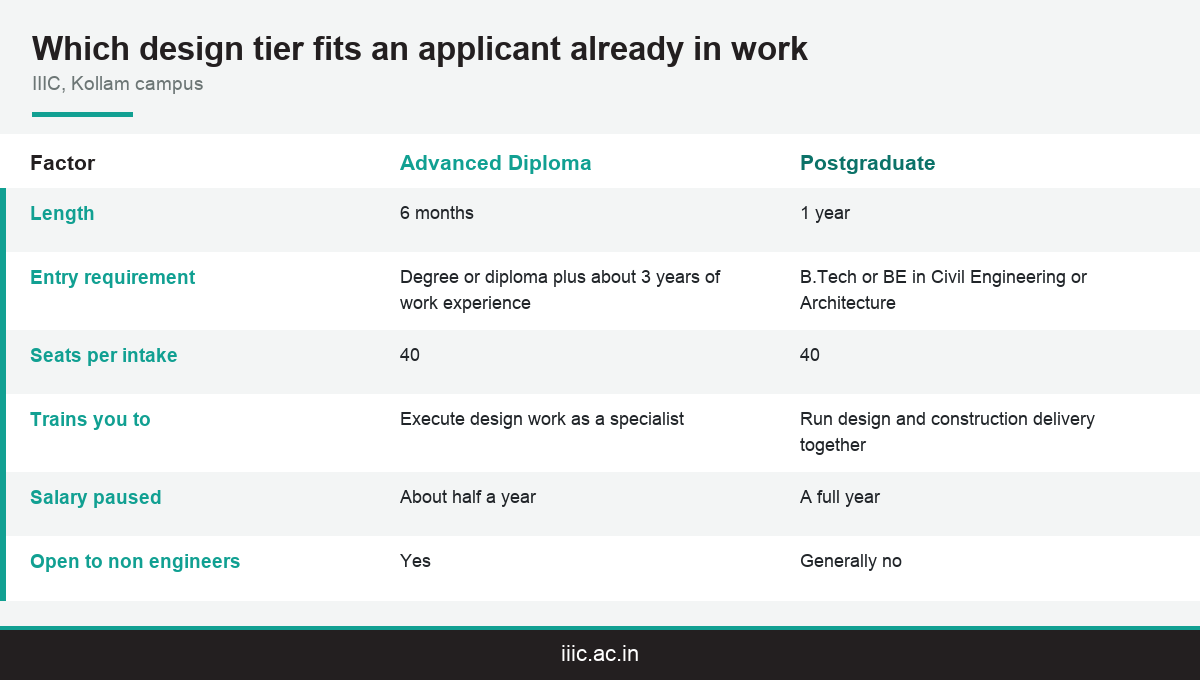
IIIC runs its design training at two levels, and only one of them is written with an experienced applicant in mind. The Advanced Diploma sits in the middle of the institute’s three tier structure, and its entry requirement is a relevant bachelor’s degree or diploma plus around three years of work experience.
That eligibility rule is the clearest signal of who the programme is for. A school leaver cannot meet it. Somebody who has spent three years in site work, drafting, furniture retail, real estate or an allied trade can, and arrives with context that shortens the learning curve considerably once studio work begins.
The six month length is the second signal. A working professional weighing a career move rarely has two years to give, and a half year programme is a materially different financial decision from a full postgraduate degree. IIIC built the tier around that constraint rather than treating it as an afterthought.
The content is narrower than a general design degree by design. Rather than a broad survey, the Advanced Diploma concentrates on the executable parts of the discipline: space planning, materials, drawings and the technical constraints a designer has to work inside on a real project rather than a portfolio brief.
You can see the shape of the programme on the AD ID programme page, which lists the current intake terms. Because seats at this tier are capped at forty per programme, a popular specialisation can close before a stated deadline.
It is worth being blunt about one thing. Being written for experienced applicants is not the same as being part time. IIIC does not publish an evening or weekend format for this programme, so plan around a genuine study break rather than assuming the course will bend around a full working week.
What an Interior Design Course for Working Professionals in Kerala Has to Deliver
An experienced applicant is buying something quite specific, and it is not inspiration. It is the ability to turn a client conversation into a set of drawings and specifications that a contractor can build from without guessing, which is the gap most self taught designers hit around their third or fourth paid project.
That means technical grounding first. Interior design as a discipline sits at the meeting point of aesthetic judgement and building constraint, and the constraint half is the part that is hard to pick up informally because mistakes only surface months later.
Materials behaviour is the clearest example in a Kerala context. Humidity, monsoon exposure and coastal air change how finishes, joinery and fixings age, and a specification that works in a dry inland climate can fail visibly within two seasons on a coastal site.
Then there is coordination. A design decision touches electrical load, plumbing routing, ventilation and structural openings, and a designer who cannot read those interactions produces drawings that get quietly redrawn on site by somebody else, which is where both margin and authorship are lost.
Practical hours matter more than lecture hours for exactly this reason. IIIC states that its training is built around roughly seventy five percent hands on work, and facilities such as the design studio are where that proportion is actually spent.
Finally, an experienced applicant needs a credential that reads clearly to an employer or a client. A named diploma from an institute with published accreditation does more work in a pitch than a portfolio alone, particularly when the client is an organisation rather than a homeowner.
Advanced Diploma or Postgraduate: Choosing Between the Two Tiers
IIIC also runs a one year postgraduate programme that combines design with construction delivery. It is not a longer version of the diploma. The entry bar is a B.Tech or BE in Civil Engineering or Architecture, which rules it out for most applicants arriving from a non engineering background.
The distinction is about the job each prepares you for. The diploma trains a specialist who executes design work well. The postgraduate track trains somebody who sits across design and construction at once, coordinating budgets, contractors and sequencing on a project rather than producing the drawings themselves.
For a working professional, that difference usually resolves quickly. If your degree is not in engineering or architecture, the decision is made for you. If it is, the question becomes whether you want to design or to run the projects that designs get built inside.
There is also a time cost difference that matters when you are giving up salary. Six months against twelve is not a small gap, and the longer programme only pays back if the management scope it opens is genuinely where you want to end up.
IIIC has published a full side by side on this exact choice. If you are torn between the two, the design tier comparison goes through both in more detail than this page has room for, including what each tier’s graduates typically do next.
The wider structure is worth knowing too. Details on the postgraduate route sit on the PGP IDC programme page, and both tiers share the same campus, the same faculty base and the same placement office, so the choice is about fit rather than quality.
Making Six Months Away From Work Actually Workable
The honest obstacle for most applicants is not academic. It is arranging six months of reduced or paused income, and applicants who plan that properly tend to be the ones who finish rather than defer.
Employer sponsorship is worth raising before you assume it is unavailable. India’s national skill development mission has pushed employers toward funding named credentials rather than informal training, and that shift works in your favour here. Contractors, developers and fit out firms in Kerala have a direct interest in staff who can specify properly, and a named six month credential is an easier internal case to make than an open ended degree.
Relocation is the other practical question, since the campus sits at Neendakara in Kollam rather than in a metro. Campus hostel accommodation exists precisely so applicants from elsewhere in the state are not commuting daily across half of Kerala.
If you are travelling from the northern districts, IIIC has written this up separately. The north Kerala applicant guide covers the logistics for Kozhikode and Thrissur applicants specifically rather than in the abstract.
Timing the application around your notice period is the last piece. Admission runs through an online application, the ATEiiic entrance assessment, a group discussion and an interview, so the gap between first enquiry and a confirmed seat is measured in weeks rather than days.
Check current intake dates directly rather than working from any article, including this one. The admissions page carries the live cycle, and windows shift from one intake to the next.
Conclusion
For anyone weighing an interior design course for working professionals in Kerala, the useful answer is not a course name but a tier. The six month Advanced Diploma is the one written around your situation, with eligibility that assumes experience rather than penalising it, while the one year postgraduate track is a different and more demanding proposition aimed at engineering and architecture graduates. Decide which of those two describes you, confirm the current format and dates with the admissions team, and plan the six months properly before you apply. Call 8078980000 or apply online at iiic.ac.in.
Frequently Asked Questions
Is there an interior design course for working professionals in Kerala at IIIC?
Yes. The six month Advanced Diploma is the tier written for experienced applicants, since its eligibility assumes a degree or diploma plus roughly three years of work experience rather than a school leaving qualification, which school leavers cannot meet.
Does IIIC run evening or weekend design classes?
IIIC does not publish a part time, evening or weekend format for its design programmes. Treat the six month diploma as a full commitment and confirm the current timetable with the admissions team before you make any decision about your job.
What qualification do I need to join the six month design diploma?
The Advanced Diploma tier generally asks for a relevant bachelor’s degree or diploma plus around three years of work experience. Seats are capped at forty per programme, so applying early in an intake window is safer than waiting for the deadline.
Can I join the postgraduate design programme without an engineering degree?
No. The one year postgraduate track generally requires a B.Tech or BE in Civil Engineering or Architecture. Applicants from other backgrounds should look at the six month diploma tier, which is where their qualification actually fits.
How long does it take to move from enquiry to a confirmed seat?
Admission runs through an online application, the ATEiiic entrance assessment, a group discussion and then a personal interview. That sequence usually takes weeks rather than days, so plan your notice period around the current intake window.
Is accommodation available if I am relocating for six months?
Yes. The Kollam campus is residential, with hostel accommodation alongside libraries, labs and a counselling cell. You can see the full list on what the Kollam campus provides before you commit to relocating for the programme.
Will an employer recognise this diploma?
IIIC is affiliated with the National Skill Development Corporation and the construction sector skill council, and operates as a Centre of Excellence under KASE. Published outcomes sit on IIIC’s placement record for you to read directly.
Is the training mostly theory or mostly practical?
IIIC states that around seventy five percent of its training is hands on. For design that means studio time, drawing work and materials handling rather than lectures, which is the part experienced applicants generally say they needed most.
Should I take the six month or the one year route?
If your degree is not in engineering or architecture, the six month diploma is the only route open to you. If it is, choose based on whether you want to produce designs or to run the projects those designs get built inside.
What does the entrance assessment involve?
The ATEiiic assessment is administered by L and T EduTech and runs seventy five minutes across fifty questions worth a hundred marks in total. It is designed to be completed in one sitting rather than spread across several days.