


PGP in MEP Systems Management: Curriculum, Software and Placement

You are kindly requested to fill out this form and select the course at IIIC that interests you so that we may get in touch with you as soon as admissions are open.
A postgraduate mep systems management course is a full year of your life, so it is worth understanding what that year is actually for before you commit to it. IIIC runs this programme at its managerial tier, and the distinction between it and the shorter diploma is not depth of the same subject but a different job at the end. This guide covers the scope, the software the field expects, and where graduates go.
Key Takeaways
- The programme sits at IIIC’s postgraduate tier: one year, forty seats, and an entry bar of a B.Tech or BE in Civil Engineering or Architecture.
- Its purpose is coordination across mechanical, electrical and public health scopes, not deeper specialisation in any one of them.
- Software fluency is assumed rather than optional now, and the categories matter more than any single product name on a syllabus.
- Confirm the current module list, fees and intake dates on the programme page, since those change between cycles and no article should be your source for them.
Where This Course Sits in IIIC’s Three Tier Structure
IIIC runs nineteen programmes across three tiers: four technician certificates, eight Advanced Diplomas and seven postgraduate programmes. A mep systems management course sits in that top tier alongside advanced construction management and road construction management.
The tier is what sets the entry bar. Postgraduate programmes generally require a B.Tech or BE in Civil Engineering or Architecture, which means applicants arrive already fluent in the engineering fundamentals the year then builds coordination skills on top of.
One year is the format, with intake capped at forty seats. That cap matters practically, because a popular specialisation can close before a published deadline, and the admission sequence itself takes weeks rather than days.
The other building services option at IIIC is a six month Advanced Diploma covering systems and facility management. It is not a shorter version of this programme. It points at operations rather than delivery, and its eligibility assumes experience instead of an engineering degree.
The practical detail for this route, including current terms, sits on the PGP MEP programme page. Read it alongside this guide, since programme pages are revised between intake cycles and articles are not.
If you are still choosing between the two tiers rather than reading up on one, IIIC publishes the building services guide on the IIIC blog, which covers the discipline more broadly than this deep dive does.
It is worth noting what the tier does not do. A postgraduate programme will not substitute for site experience, and the strongest graduates tend to be the ones who treat the year as a way to organise and formalise knowledge they already have some contact with rather than as a first exposure.
What the Curriculum Has to Cover to Be Credible
Rather than reproduce a module list that changes between cycles, it is more useful to set out what any credible programme in this discipline has to cover, so you can check the current syllabus against it yourself when you read the programme page.
The mechanical half starts with air movement and thermal comfort. HVAC design logic, load estimation, duct and pipe sizing and plant selection are the foundation, because almost every other services decision on a building is constrained by them.
The electrical half covers distribution, load calculation, protection, earthing and increasingly the controls layer that sits over the top of both mechanical and electrical systems in a modern building.
Public health engineering is the part applicants underestimate most. Water supply, drainage, pumping, storage and treatment are unglamorous and are also where the most expensive and most visible failures happen on completed buildings.
Then comes the layer the title actually promises. Coordination, sequencing, interface management, procurement and commissioning are what turn a technically competent engineer into somebody who can carry a services package on a live project.
Standards literacy belongs in there too. Working knowledge of the codes an inspector will apply, and of guidance from bodies such as ASHRAE, is what lets a graduate defend a design decision rather than simply assert it.
Practical time is the last test, and the most important one. IIIC puts the hands on share of its training at roughly seventy five percent, and workshops such as the plumbing lab are where that proportion is spent rather than in a simulation.
The Software the Field Expects You to Know
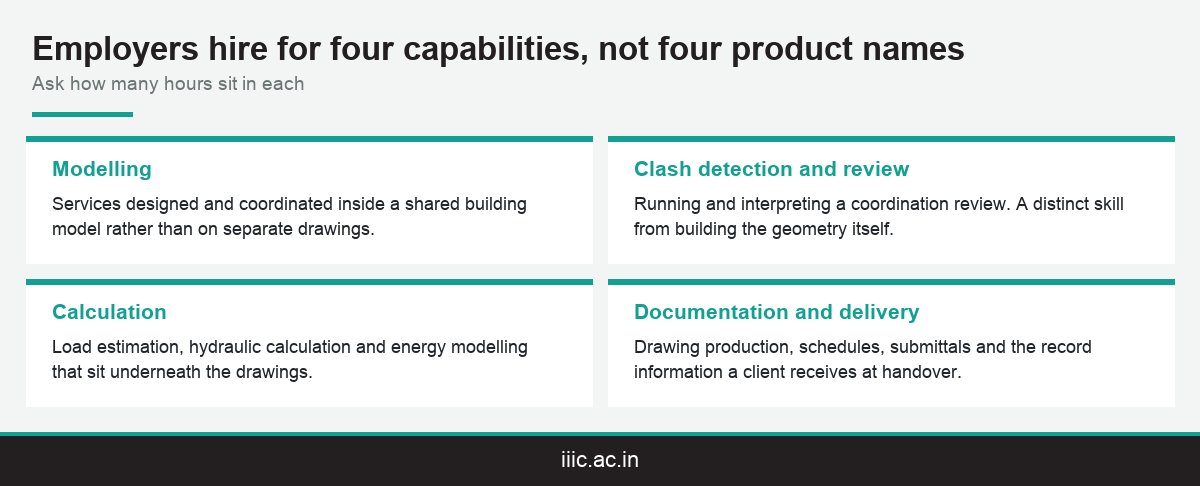
Software questions dominate enquiry calls, usually in the form of a single product name. That is the wrong frame. Employers hire for categories of capability, and the specific product varies by firm and by project.
The first category is modelling. Services are increasingly designed and coordinated inside a shared building model rather than on separate drawings, and tools such as Revit are the common denominator for that work across most of the industry.
The second is clash detection and coordination review, which is a distinct skill from modelling. Being able to run and interpret a coordination review is often what separates a services engineer who can hold a package together from one who cannot.
The third is calculation. Load estimation, hydraulic calculation and energy modelling tools sit underneath the drawings, and an engineer who can only draw what somebody else calculated is limited in what they can be trusted with.
The fourth is documentation and delivery: drawing production, schedules, submittals and the record information a client receives at handover. It is administrative in feel and commercially critical in practice.
What to ask the institute is therefore not whether they teach one named product, but which categories are covered, how many hours are spent in each, and whether students work on a coordinated project rather than isolated exercises.
IIIC also runs a dedicated services internship, and that is worth asking about separately. The building services internship is where software familiarity turns into something an employer will accept as experience.
Placement, Recruiters and What Graduates Actually Do
IIIC publishes placement figures per programme rather than as one institute wide claim, which is the more useful format. Reported rates include ninety five percent for advanced construction management and a hundred percent for the GIS and GPS certificate programme.
Named recruiting partners across the institute include Reliance, Ultratech, Berger and Sobha alongside firms such as ESRI India and Le Meridien, spanning more than fifty organisations across construction, materials, technology and hospitality.
The placement outcomes page carries the current list. When you read it, look for which employers hire into building services specifically rather than assuming the institute wide list applies evenly across every programme.
Graduate roles from this tier tend to sit on the delivery side: services coordination on live projects, contractor and subcontractor management, and technical client side positions between a consultant and the firms installing the work.
That is a project shaped career, with a start, a handover and a move to the next site. It suits people who like a defined finish line and are comfortable with the pressure that builds as one approaches.
The Gulf question comes up in most enquiries and deserves a careful answer. A credential mapped to a recognised national skill body is easier to explain to an overseas employer than an unaccredited certificate, but no institute can promise an overseas posting.
Cost is the last consideration. Applicants searching mep course fees in kerala should weigh tuition alongside a year of foregone salary and accommodation, since for most people the second of those three is the largest number in the calculation.
Conclusion
A postgraduate mep systems management course is worth a year only if delivery side coordination is genuinely where you want to work. The tier assumes an engineering or architecture degree at entry, spends its time on the coordination layer above the individual disciplines, and points graduates at project roles rather than operations. If that describes you, read the programme page for current modules, fees and intake dates, and start the application early because seats are capped at forty. Call 8078980000 or apply online at iiic.ac.in.
Related Reading
Frequently Asked Questions
What does the MEP systems management course at IIIC cover?
It covers mechanical, electrical and public health systems plus the coordination layer above them: sequencing, interface management, procurement and commissioning. The current module list sits on the programme page, which is revised between intake cycles.
How long is the programme and how many seats are there?
It runs one year at IIIC’s postgraduate tier, with intake capped at forty seats. Because popular specialisations can close before a published deadline, applying early in an intake window is consistently safer than waiting for one.
What qualification do I need to apply?
The postgraduate tier generally requires a B.Tech or BE in Civil Engineering or Architecture. Applicants from other backgrounds should look at the six month Advanced Diploma tier, where eligibility is built around a degree plus work experience.
Which software will I need to learn?
Think in categories rather than product names: modelling, clash detection and coordination review, calculation, and documentation. Employers hire for capability in those four areas, and the specific product varies between firms and from one project to the next.
How is this different from the six month facility management diploma?
This route trains you to deliver services on a project. The diploma trains you to operate them afterwards across a building’s life. They share a technical vocabulary but lead to genuinely different day to day working lives and different employers.
Is there an internship attached to the programme?
IIIC runs a separate building services internship listing that is worth asking the admissions team about directly. Internship experience is usually what converts software familiarity into something an employer is willing to treat as real evidence of capability.
What accreditation stands behind the qualification?
IIIC is affiliated with the National Skill Development Corporation and the construction sector skill council, and operates as a KASE Centre of Excellence in partnership with ULCCS. The full published record sits on IIIC’s accreditation and affiliation page.
Is the training mostly practical?
IIIC puts the hands on share of its training at roughly seventy five percent across the institute. For building services that means workshop time on real plant rather than simulated exercises, which is the part employers actually value.
How do I apply and how long does it take?
Applications run through an online form, the ATEiiic entrance assessment, a group discussion and then a personal interview. Current dates sit on the admissions page, and the whole sequence usually takes weeks rather than days to complete.
What roles do graduates typically move into?
Delivery side positions are the common destination: services coordination on live projects, contractor and subcontractor management, and technical client side roles sitting between a design consultant and the firms actually carrying out the installation work.