


MEP Careers at IIIC: Systems Management vs Facility Management

You are kindly requested to fill out this form and select the course at IIIC that interests you so that we may get in touch with you as soon as admissions are open.
Anyone comparing training options quickly runs into the same phrase, and the honest answer to which is the best mep training institute in kerala depends less on the institute than on which of two very different careers you are aiming at. Building services splits into delivery and operations, and those are separate jobs with separate skills. IIIC runs a distinct programme for each. This page is a decision hub for choosing between them, not a repeat of either programme page.
Key Takeaways
- MEP work divides into two careers: designing and delivering systems on a project, and running them afterwards across a building’s operating life. IIIC trains for both, separately.
- The one year postgraduate track covers systems and management and asks for a B.Tech or BE in Civil Engineering or Architecture at entry.
- The six month Advanced Diploma covers systems and facility management and asks instead for a relevant degree or diploma plus roughly three years of work experience.
- Judge any institute on accreditation, practical hours and published placement outcomes rather than on the word best, and check fees per programme rather than per institute.
What MEP Actually Covers on an Indian Construction Project
MEP stands for mechanical, electrical and plumbing, and on a modern project it is the layer that turns a structure into a usable building. Air handling, ventilation, power distribution, water supply, drainage, fire protection and increasingly building automation all sit inside it.
It is also the layer where most project clashes happen. Structure and architecture are relatively fixed, but services have to be routed through whatever space is left, which is why coordination skill matters as much as technical knowledge in this discipline.
The scope has widened considerably over the last decade. Building services engineering now routinely includes energy performance, metering and controls, because clients are held to operating cost targets rather than just handover dates.
That widening is what created two distinct career tracks. Somebody has to design and install the systems during the project, and somebody else has to keep them running efficiently for the twenty or thirty years afterwards. Those are different working lives with different daily rhythms.
In Kerala the demand shows up on both sides. Commercial, hospitality and healthcare construction generates delivery work, while the growing stock of completed buildings generates a steady operations and maintenance market that does not disappear when a project pipeline slows.
The regulatory picture has tightened alongside that growth. Fire safety provisions, electrical standards and water and drainage requirements are all inspected rather than assumed, and a services engineer who cannot evidence compliance creates a problem that surfaces at handover, when it is most expensive to fix.
None of this is learnable purely from a textbook. Reading a schematic is one skill and standing in a plant room working out why a system behaves differently from its drawing is another, which is why the practical proportion of any building services programme deserves more scrutiny than its syllabus list.
IIIC’s Two MEP Routes at a Glance
IIIC runs nineteen programmes across three tiers, and building services appears at two of them. That is deliberate rather than accidental duplication: the two programmes serve different applicants heading toward different roles.
At the postgraduate level sits a one year programme in MEP systems and management, part of the seven programme managerial tier that requires a B.Tech or BE in Civil Engineering or Architecture. Seats are capped at forty.
At the Advanced Diploma level sits a six month programme in MEP systems and facility management, one of eight diplomas at that tier. Its eligibility is written around a relevant degree or diploma plus roughly three years of experience, also with forty seats.
The naming is the giveaway. Both carry MEP systems, but only one carries facility management, and that single phrase is the difference between training for the build phase and training for everything that comes after it.
Both sit on the same 9.2 acre campus at Neendakara in Kollam, draw on the same labs and the same placement office, and both are covered by the same institutional accreditation. The choice between them is about fit, not quality.
It also helps to see where each sits in the wider ladder. IIIC runs four technician certificates, eight Advanced Diplomas and seven postgraduate programmes, and the two building services options occupy one slot each at the upper two tiers rather than competing for the same applicant.
A first enrolment does not have to be a final one either. A diploma graduate who later completes a qualifying engineering degree can return at the postgraduate tier, and the institute is deliberately structured so that moving between tiers over a career stays realistic rather than theoretical.
The Postgraduate Route: Systems and Delivery
The postgraduate track is aimed at engineering and architecture graduates who want to lead the services scope on a project rather than execute a slice of it. It sits at IIIC’s managerial tier alongside construction management and road construction management.
Its length is the first practical signal. A full year is a serious commitment, and it buys breadth: systems knowledge across mechanical, electrical and plumbing plus the management layer that lets a graduate coordinate contractors, budgets and sequencing rather than only specify equipment.
Full curriculum detail, current intake terms and eligibility sit on the PGP MEP programme page. Read that alongside this page rather than instead of it, since programme pages change between intake cycles and this one does not.
One thing worth understanding early is what the management half actually implies in practice. A services lead is accountable for a package that several subcontractors deliver, which means the job is as much about sequencing, interfaces and commercial discipline as it is about the engineering itself.
That accountability is also why the entry bar sits where it does. A programme cannot teach coordination across mechanical, electrical and public health scopes to somebody still learning the underlying engineering, so the degree requirement is doing real work rather than filtering for prestige.
Who this route is written for
The entry bar answers this fairly bluntly. A B.Tech or BE in Civil Engineering or Architecture is the expected qualification, which means the typical applicant is a recent graduate or an early career engineer rather than somebody switching in from an unrelated field. If your degree is in another discipline, the diploma tier is the realistic route rather than this one.
What the year is actually spent on
IIIC states that roughly seventy five percent of its training is hands on across the institute, and at this tier that practical proportion goes into systems work and coordination rather than lectures. The management half of the title is not decorative: the programme exists to produce somebody who can sit above several trades at once and hold a services package together.
Where graduates typically end up
Delivery side roles are the natural destination. That means services coordination on live projects, contractor management, and the technical client side positions that sit between a design consultant and the firms actually installing the work. It is a project rhythm career, with the intensity and the mobility that implies.
The Advanced Diploma Route: Systems and Facility Management
The six month diploma covers the same technical systems but points them at a different question: not how do we install this, but how do we run it well for the next two decades. That is the facility management half of the title.
Operations is a larger employment market than most applicants expect. Every completed hospital, hotel, mall, campus and office block needs somebody who understands its services, and that need does not pause when new construction slows down.
Current terms sit on the AD MEP FM programme page. IIIC has also published a longer written guide to this diploma, which is worth reading if you want depth on the curriculum itself.
The commercial logic behind this route is easy to miss. A building consumes far more money across its operating life than it cost to fit out, so an operator who can reduce energy use or extend plant life is measured directly against a budget line that repeats every year.
That is also why the role has become more technical rather than less. Metering, building management systems and planned maintenance software have turned facility management into a data driven discipline, and employers increasingly expect a named credential rather than accumulated site familiarity alone.
Who this route is written for
Eligibility assumes experience: a relevant bachelor’s degree or diploma plus around three years of work. That makes it the practical option for somebody already in a technical or site role who wants a named credential, and for applicants whose degree is not in Civil Engineering or Architecture and who therefore cannot enter at the postgraduate tier at all.
Why operations is a different skill set
Facility management rewards diagnostic thinking, planned maintenance discipline and cost control rather than design judgement. The daily question is why a chiller is drawing more power than it did last quarter, not which chiller to specify. Both are technical, but they use different reflexes.
The six month trade off
Half a year is easier to fund and easier to explain to an employer than a full postgraduate year, and it is why this tier suits people who are already earning. The trade off is scope: the diploma trains a strong specialist, while the postgraduate track trains somebody expected to coordinate across disciplines.
How the Two Careers Diverge After Graduation
The clearest way to choose is to picture the working week each route leads to, because they genuinely do not resemble each other much beyond the shared technical vocabulary.
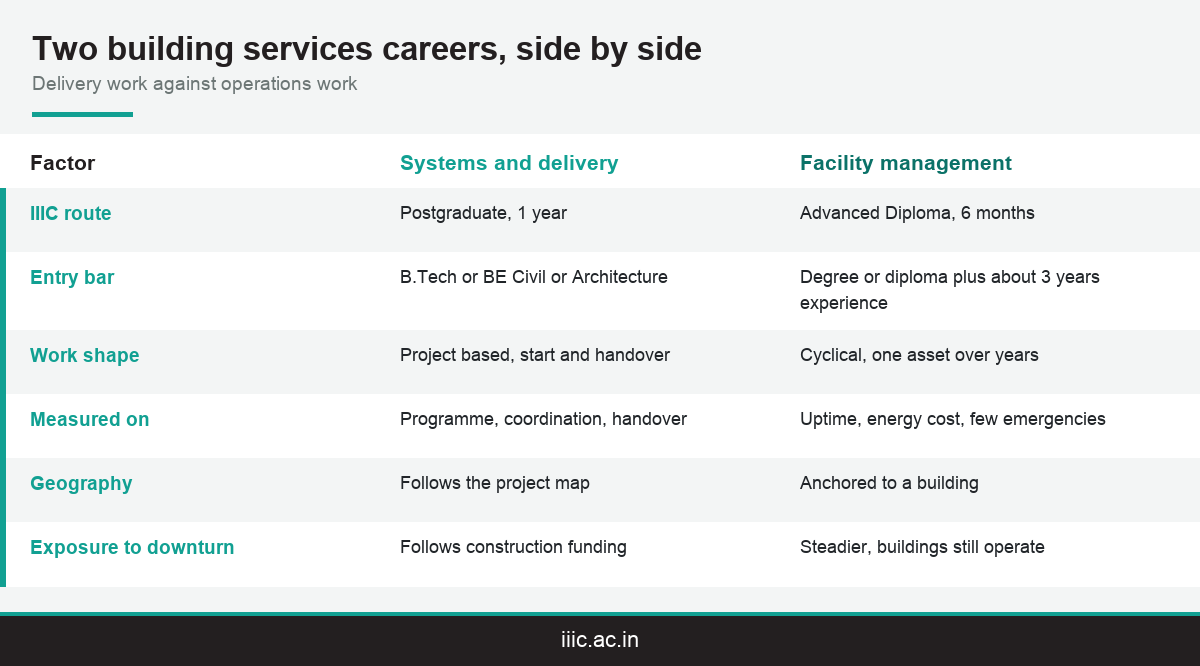
Delivery work is project shaped. It has a start, a handover and a move to the next site, often in a different city or country. It suits people who like a defined finish line and are comfortable with the pressure that comes near one.
Operations work is cyclical. The same building, the same systems, improved incrementally over years, measured on uptime, energy cost and how few emergencies occur. It suits people who prefer depth in one asset over breadth across many.
Pay progression differs in shape rather than in ceiling. Delivery roles tend to move faster early and depend on project availability. Operations roles build more slowly but are less exposed to a construction downturn, which matters over a full career.
Neither is the safer choice in the abstract. The mistake is choosing the longer programme because it sounds more advanced, then discovering you wanted the other working life. Six months or a year is a lot to spend finding that out.
Geography differs too, and it is worth thinking about honestly. Delivery roles follow the project map, which in this sector often means moving between Kerala, other Indian states and the Gulf. Operations roles are anchored to an asset, which suits anyone who wants to stay put.
A useful test is to ask which frustration you would rather live with. Delivery people complain about programme pressure and last minute design changes. Operations people complain about deferred budgets and inherited installations. Both complaints are real, and most people find one clearly easier to tolerate than the other.
Ask the question early rather than late. The two routes are close enough on paper that many applicants defer the decision until after they enrol, which is precisely when it becomes expensive to change, because a programme place is committed for its full duration once a cycle has started.
What to Check Before You Call Any Institute the Best
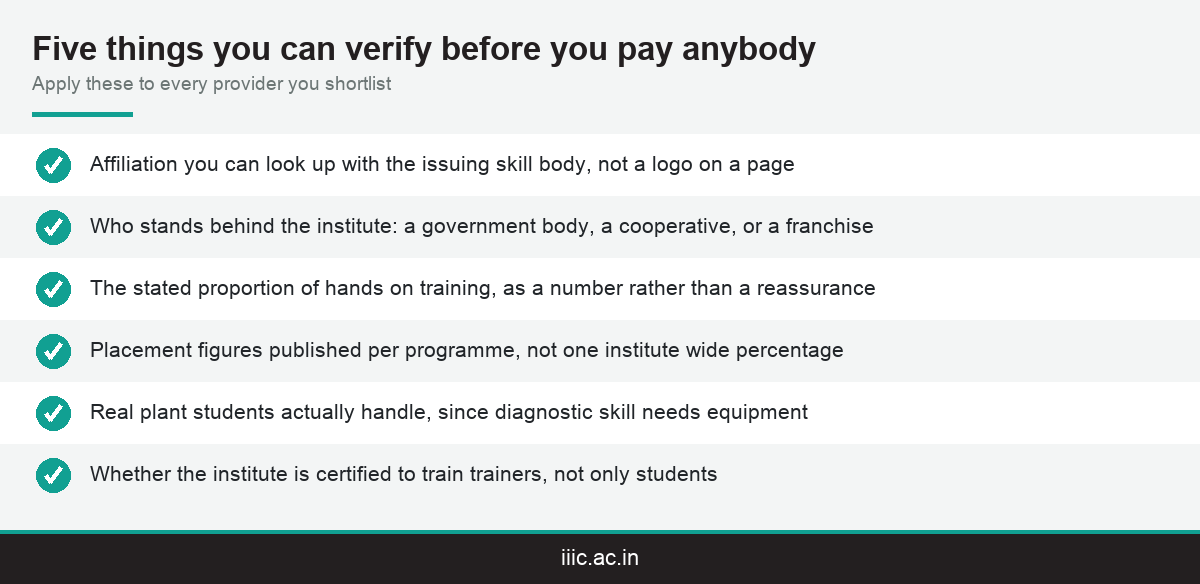
The word best does very little work on its own, so it is worth replacing it with four checks you can actually verify before enrolling anywhere, at IIIC or elsewhere.
First, accreditation you can look up. IIIC is affiliated with the National Skill Development Corporation across thirteen sectors and separately with the Construction Skill Development Council of India, and both are listed on IIIC’s accreditation and affiliation page.
Second, who stands behind the institute. IIIC operates as a Centre of Excellence under the Kerala Academy for Skills Excellence and is managed in partnership with ULCCS, a worker cooperative active in Kerala infrastructure since 1925. That is a different kind of backing from a private franchise.
Third, practical hours. Ask what proportion of contact time is hands on and where it happens. IIIC puts that figure at roughly seventy five percent and runs dedicated facilities, including the plumbing lab and the electrical lab.
Fourth, published outcomes at programme level rather than one institute wide number. A single headline percentage is easy to produce and hard to interpret, which is the point of the next section.
A fifth check is worth adding for building services specifically: ask what equipment students actually handle. Services training without real plant is close to useless, because the diagnostic skill an employer is paying for only develops in front of a system that is misbehaving.
Finally, ask who trains the trainers. IIIC is currently the only Training of Trainers centre in Kerala, meaning it is certified to train instructors who then teach elsewhere. That is a different tier of recognition from being permitted to teach students directly, and it is straightforward to verify.
Fees, Duration and the Real Cost of Each Route
Applicants searching mep course fees in kerala usually want a single number, and no honest article can give one, because IIIC prices per programme and revises terms between intake cycles. The two programme pages carry the current figures.
What an article can do is frame the comparison properly. The headline fee is only one of three costs, and for most applicants it is not the largest one.
The second cost is time out of earning. A year at the postgraduate tier is twice the foregone salary of six months at the diploma tier, and that gap is usually larger than any difference in tuition between the two.
The third is relocation, since the campus sits at Neendakara in Kollam rather than in a metro. Campus hostel accommodation exists for exactly this reason and should be priced into the comparison rather than treated as an extra.
Set against those costs, ask what each route unlocks. If a six month diploma moves you into a named operations role, the payback period is short. If you need the postgraduate tier to reach the coordination roles you actually want, the extra six months is the cheaper mistake to avoid.
Employer sponsorship is worth testing before you assume it is unavailable. Contractors and facilities operators have a direct interest in staff who can evidence compliance and hold a services package together, and a named six month credential is an easier internal case than an open ended degree.
Whatever the figures turn out to be, compare like with like. A cheaper programme with no verifiable accreditation, no published outcomes and little practical time is not actually cheaper once you account for what it fails to open, which is the whole point of the checks above.
Placement, Recruiters and the Gulf Question
IIIC publishes placement figures at programme level rather than as one institute wide claim. Reported rates include ninety five percent for advanced construction management, ninety two percent for urban planning design and management, and a hundred percent for the GIS and GPS certificate programme.
Named recruiting partners across the institute include Reliance, Ultratech, Berger and Sobha alongside firms such as ESRI India, Club Mahindra and Le Meridien, spanning more than fifty organisations. The spread matters as much as the percentages.
You can read the current list on the placement outcomes page and check which recruiters actually hire into building services rather than assuming the institute wide list applies evenly to every programme.
The Gulf question comes up in almost every enquiry, and it deserves a careful answer. Kerala professionals have long moved into Gulf construction markets, and a credential mapped to a recognised national skill body is generally easier to explain to an overseas employer than an unaccredited certificate.
That is a portability advantage, not a placement guarantee, and no institute can promise an overseas posting. Treat it as one factor among several rather than the reason to choose a programme.
It is also worth asking which of the two routes travels better. Operations roles exist wherever buildings exist, which spreads the opportunity widely, while delivery roles concentrate wherever construction is currently funded, which moves over time and is harder to predict a year in advance.
The institute runs an annual placement conclave alongside its ongoing recruiter relationships, and that is the point at which programme level differences become visible. Ask the admissions team which employers attended for building services specifically in the last cycle rather than accepting the institute wide list.
One last piece of due diligence costs nothing. Ask to speak to a graduate of the specific programme you are considering, not of the institute in general, and ask them what their first six months in the job actually involved. That single conversation tends to settle the delivery versus operations question faster than any brochure, and a confident institute will arrange it.
Conclusion
The question of which is the best mep training institute in kerala is worth reframing before you answer it. IIIC offers two building services routes that lead to genuinely different careers: a one year postgraduate track for engineering and architecture graduates heading into project delivery, and a six month Advanced Diploma for experienced applicants heading into operations and facility management. Both sit inside the same accreditation structure on the same Kollam campus. Work out which working life you want first, then read the relevant programme page for current fees and intake dates, or call 8078980000 to talk it through.
Frequently Asked Questions
Which is the best MEP training institute in Kerala?
Judge institutes on accreditation you can verify, published programme level placement figures and the proportion of practical training, rather than on the claim itself. IIIC publishes all three, which lets you compare it against alternatives on evidence.
What is the difference between MEP systems management and facility management?
Systems management trains you to design and deliver building services during a project. Facility management trains you to operate and maintain those same systems afterwards. They share a technical vocabulary but lead to genuinely different day to day working lives.
How long is each MEP programme at IIIC?
The postgraduate systems and management programme runs one year at IIIC’s managerial tier. The Advanced Diploma in systems and facility management runs six months. Both cap intake at forty seats per programme, so early application matters.
What qualification do I need for the postgraduate MEP route?
The managerial tier generally requires a B.Tech or BE in Civil Engineering or Architecture. Applicants from other backgrounds should look at the six month Advanced Diploma instead, where eligibility is built around a degree plus experience.
What are the MEP course fees in Kerala at IIIC?
IIIC prices per programme and revises terms between intake cycles, so the two programme pages carry current figures rather than any article. Factor in foregone salary and accommodation alongside tuition when you compare the two routes.
Can I switch from facility management into project delivery later?
Yes, and IIIC’s tiers are structured so that a diploma graduate can return later for a postgraduate programme if they hold a qualifying engineering degree. Career changes across the two tracks are common rather than unusual in this field.
Does IIIC have practical labs for building services training?
Yes. The campus runs dedicated workshops for the relevant trades, and you can see the full range on the labs and workshops page before you decide. Around seventy five percent of training is hands on.
Will an IIIC credential help with jobs in the Gulf?
A qualification mapped to a recognised national skill body is generally easier to explain to an overseas employer than an unaccredited certificate. That is a portability advantage rather than a guarantee of any particular overseas posting.
How do I apply to either MEP programme?
Applications run through an online form, the ATEiiic entrance assessment, a group discussion and then an interview. Current intake dates sit on how to apply to IIIC, and windows shift between cycles, so check them directly rather than relying on any article.
Which route suits somebody already working in a site role?
Usually the six month Advanced Diploma, because its eligibility assumes a degree or diploma plus around three years of experience and its length is far easier to fund than a full postgraduate year away from salary.