


Quality, Safety, Surveying and Contracts Careers at IIIC

You are kindly requested to fill out this form and select the course at IIIC that interests you so that we may get in touch with you as soon as admissions are open.
The disciplines that sit between design and delivery get less attention than either, which is why a quantity surveyor course in india is often researched in isolation from the safety and quality roles alongside it. They belong together. Measurement, contracts, quality and safety are four control functions on the same project, and IIIC trains them as separate diplomas. This hub helps you pick between them.
Key Takeaways
- IIIC covers these four disciplines through three Advanced Diplomas: quantity surveying with contracts management, quality assurance with quality control, and environment health and safety.
- All three sit at the six month diploma tier, which asks for a relevant degree or diploma plus roughly three years of work experience rather than a fresh engineering degree.
- The four roles share a mindset, checking work against a defined standard, but differ sharply in what that standard is and what a bad day looks like.
- These are among the most portable construction credentials, because measurement, compliance and safety obligations exist on every project everywhere.
Four Control Functions That Sit Between Design and Delivery
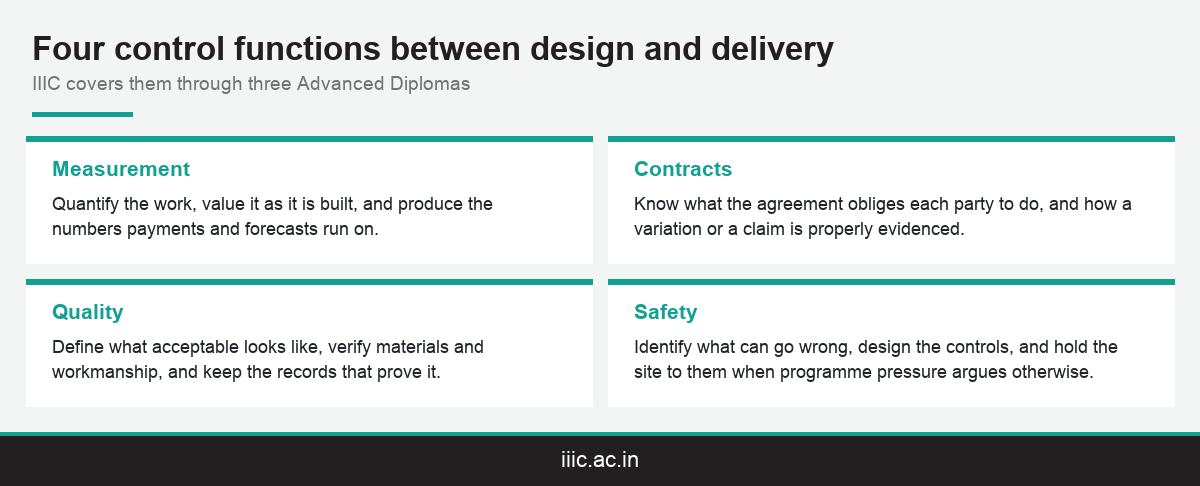
Every construction project has people who design it and people who build it. Between them sits a smaller group whose job is to check that what gets built matches what was agreed, at the price agreed, to the standard agreed, without hurting anybody.
Measurement is the first of those functions. Somebody has to quantify what is being built, value it as it progresses, and produce the numbers that payments and forecasts are based on.
Contracts is the second. Somebody has to understand what the agreement actually obliges each party to do, what happens when circumstances change, and how a claim or a variation is properly documented rather than argued about later.
Quality is the third. Somebody has to define what acceptable work looks like, verify that materials and workmanship meet it, and keep the records that prove it when a client or an auditor asks.
Safety is the fourth, and the one with the least negotiable consequences. Somebody has to identify what can go wrong, put controls in place, and hold the site to them when programme pressure argues otherwise.
These four share a temperament. All of them involve holding a line against pressure from people who want to move faster, and all of them are judged partly on problems that did not happen, which is a particular kind of professional patience.
They are also, for the same reason, careers with unusual longevity. Every project needs them, in every market, and the obligations they manage are written into contracts and law rather than into fashion.
What they are not is administrative. Each of the four requires enough construction knowledge to know when an answer is wrong, and somebody who understands the paperwork but not the work is easily talked past by anybody who does.
That combination is what makes these roles harder to fill than their profile suggests, and it is why the diploma tier asks for site experience at entry rather than treating them as subjects that can be learned entirely from a classroom.
Measurement and Contracts: What This Role Actually Involves
IIIC covers both halves of this discipline in one six month Advanced Diploma, which reflects how the role works in practice: the person who measures the work is usually the person who understands what the contract says about paying for it.
Current terms sit on the AD QSCM programme page. Read it for eligibility and intake dates rather than relying on any article, since programme pages are revised between cycles.
IIIC has also published a longer written piece on this career specifically. IIIC’s measurement career guide covers scope and progression in more depth than a decision hub can, and is worth reading if this discipline is already your front runner.
One thing worth knowing before you commit. This is the most commercial of the four roles, and the people who do well in it are comfortable with disagreement about money as a routine part of the working week rather than as a sign something has gone wrong.
It is also the discipline with the clearest route into senior commercial positions. Cost management, procurement and commercial leadership on large projects are all reached from this starting point, and the ladder is well defined by construction standards.
The measurement half
A quantity surveyor quantifies work from drawings, values it as it is built, and produces the interim valuations that payments run on. The skill is not arithmetic. It is knowing what a drawing actually implies in materials and labour, and being able to defend that view when somebody with a different number disagrees.
The contracts half
Contract literacy is what turns a measurer into a commercial professional. Understanding obligations, notice requirements, variations and how a claim is properly evidenced is the difference between a project that recovers its costs and one that argues about them for two years after completion. This half is written and procedural rather than technical.
Professional pathways beyond the diploma
IIIC lists alignment with the pathway offered by the Royal Institution of Chartered Surveyors among its affiliations, and professional membership is a common long term ambition in this field. Treat that as a direction rather than an automatic outcome, and ask the admissions team exactly what the current alignment covers before you rely on it.
Quality Assurance and Quality Control Are Not Synonyms
These two words are used interchangeably in job adverts and mean different things, which is worth sorting out before you choose a programme built around both.
Assurance is preventive and systemic. It is the set of processes, procedures and checks designed so that defective work is unlikely to happen in the first place, and it lives mostly in documents and audits.
Quality control is detective and physical. It is the testing, inspection and verification that catches what has already been done, and it lives mostly on site and in a materials laboratory.
A competent practitioner does both, which is why IIIC teaches them as one six month diploma. Current terms sit on the AD QA/QC programme page.
Standards literacy underpins the whole discipline. Specifications published by bodies such as the Bureau of Indian Standards define what acceptable means, and a quality professional who cannot cite the standard is expressing an opinion rather than making a determination.
The materials side is where the practical training matters most. IIIC runs the QA/QC laboratory on campus, and testing skill is built by doing tests rather than reading about them.
For a fuller treatment of this specific career, IIIC publishes its QA/QC certification guide, which covers the role and its progression at greater length than this hub allows.
The documentation side deserves more respect than it usually gets. An inspection that happened but was not recorded properly is, for contractual purposes, an inspection that did not happen, and that lesson is normally learned expensively rather than in advance.
Timing is the other discipline specific skill. A great deal of construction work is concealed shortly after it is completed, so a quality professional who inspects late is left choosing between opening up finished work and accepting something unverified.
Environment, Health and Safety: The Least Negotiable Discipline
Safety differs from the other three in one important respect. A measurement dispute costs money and a quality failure costs rework, but a safety failure costs somebody their health, and occasionally their life.
That changes the character of the job. Occupational safety and health work involves hazard identification, risk assessment, control design, training and the authority to stop work when controls are not in place.
The environmental half has grown considerably. Waste, emissions, water and noise obligations now sit alongside worker safety on most sizeable projects, and clients increasingly audit them with the same seriousness.
IIIC covers both in a six month diploma. Terms sit on the AD EHS programme page, and the institute publishes its safety career guide separately for anybody who wants the fuller picture.
The temperament this role needs is specific. You have to be comfortable being the least popular person on site occasionally, and confident enough to hold a position when a programme is slipping and the pressure to look away is real.
It is also a role with unusually clear progression. Safety responsibility scales with project size and risk, and experienced practitioners move into corporate roles covering multiple sites rather than deeper technical specialisation.
Demand has been steadier than for many construction roles, because safety obligations do not reduce when a market softens, and a project running with fewer people still needs the same compliance function.
The credential question matters more here than in most disciplines too. Clients and principal contractors are increasingly required to verify the competence of the people holding safety responsibility, which means a recognised qualification is often a condition of the role rather than an advantage in applying for it.
How the Four Careers Differ Day to Day
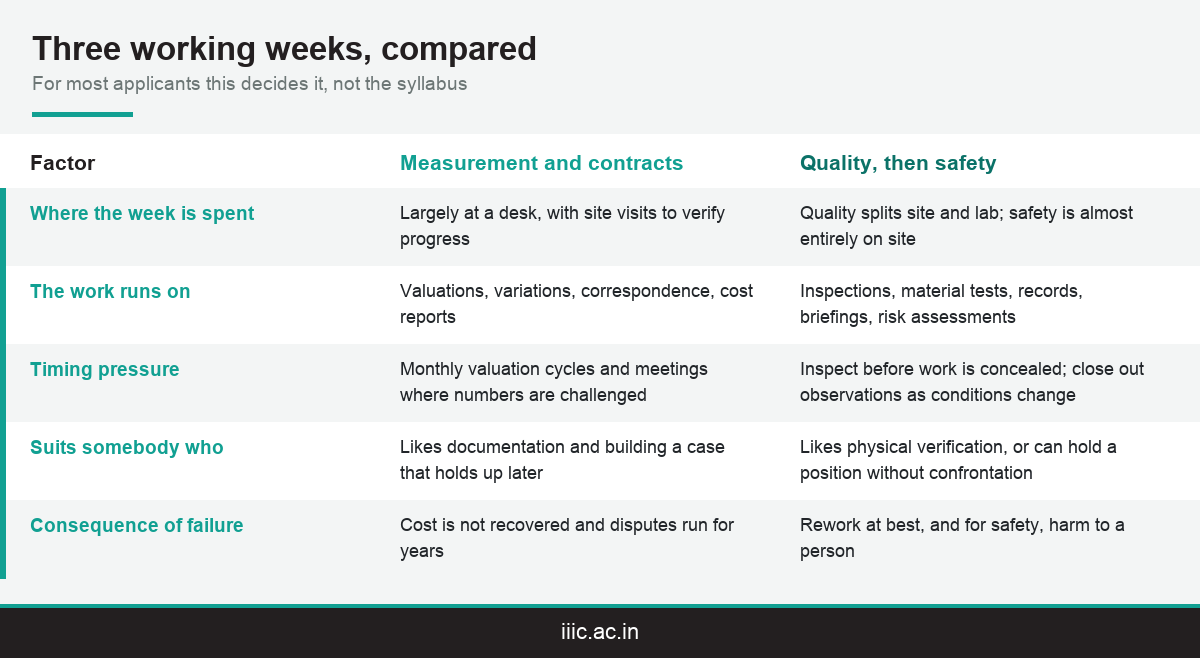
Comparing syllabuses tells you less than comparing working weeks, so it is worth picturing what each of these roles actually does between Monday and Friday.
All four are checking functions, but the thing being checked differs, and so does the evidence each one relies on to make a determination stick.
The balance between desk and site differs too, and for most people that is the deciding factor rather than the subject matter itself.
None of them is a quiet job. All four involve telling people things they would rather not hear, which is worth being honest with yourself about before you commit six months to any of them.
The three sketches below are generalisations, and any individual role will differ with the project, the employer and the stage of work. Use them as a prompt for what to ask a practitioner rather than as a description of what your own week would look like.
It is worth asking that question of somebody actually doing the job. A single conversation about how a real week runs settles this choice more reliably than any comparison of syllabuses, and most people in these roles are happy to describe them honestly.
The measurement and contracts week
Largely desk based with regular site visits to verify progress. The week runs on valuations, variation records, correspondence and cost reports, punctuated by meetings where numbers get challenged. It suits people who like documentation, precision and building a case that holds up under scrutiny months later.
The quality week
Split between site inspection, materials testing and record keeping. The rhythm follows the work: inspections before concealment, tests as materials arrive, and the documentation trail that proves both happened. It suits people who like physical verification and are not bored by careful, repetitive procedure.
The safety week
Predominantly on site, walking the works, running briefings, closing out observations and updating risk assessments as conditions change. It is the most people facing of the four and the most immediate. It suits people who can hold a position under pressure without turning every conversation into a confrontation.
Eligibility, Format and What the Diploma Tier Assumes
All three programmes sit at IIIC’s Advanced Diploma tier, which is the middle of the institute’s three tier structure and where it runs the largest number of distinct programmes, eight in total.
The format is six months with forty seats per programme. That length is deliberate: it is short enough for somebody already earning to consider, and long enough to build a genuine specialisation rather than an introduction.
Eligibility generally requires a relevant bachelor’s degree or diploma plus around three years of work experience. That rule is doing real work, because all four of these disciplines are much easier to learn once you have seen a project run.
It also means these are not routes for school leavers. Applicants at that stage should look at IIIC’s technician tier, which accepts a school leaving qualification and has thirty seats per programme.
That is not a consolation prize either. A technician graduate who spends a few years on site and later completes a qualifying degree comes back to this tier with exactly the combination the eligibility rule is written around, which is how the ladder is meant to work.
For engineering graduates without experience, the postgraduate tier is the alternative, though its seven programmes are weighted toward delivery management rather than these control functions specifically.
Cost should be weighed as three numbers rather than one: tuition, six months of reduced or foregone earnings, and accommodation if you are relocating to the Kollam campus. The second is usually the largest.
Employer sponsorship is worth testing before assuming it is unavailable. Contractors have a direct commercial interest in staff who can evidence compliance and defend a valuation, and a named six month credential is an easier internal case than an open ended degree.
Relocation is the practical question for applicants from outside the district, since the campus sits at Neendakara in Kollam on National Highway 66. The campus is residential, with hostel accommodation alongside a cafeteria, library and counselling cell.
Seats being capped at forty per programme has a practical consequence worth planning around. A popular specialisation can close before its published deadline, and the admission sequence itself takes weeks, so an early enquiry costs nothing and a late one can cost a cycle.
Facilities, Internships and Practical Evidence
These are practical disciplines, and the honest test of a programme is what a student physically does rather than what the syllabus lists.
IIIC puts the hands on share of its training at roughly seventy five percent across the institute, and for quality work that proportion is spent in the materials laboratory rather than in a lecture theatre.
The wider workshop estate matters here as well, because quality and safety are assessed against real construction activity. The labs and workshops page lists what the campus runs, from masonry and formwork through to services trades.
Supervised project experience is the other half. The QA/QC internship is listed separately, and internship output is what a first employer will actually interview you against.
Ask what you leave with in each case. For measurement that means valuations you produced; for quality, test records and inspection reports; for safety, risk assessments and a method statement you wrote rather than copied.
Documentation skill runs through all three, and it is chronically undertrained. Much of what these professionals produce is a written record intended to be read by somebody else under pressure, possibly years later, possibly in a dispute.
A campus visit answers most of this in an afternoon. Walk through the testing laboratory, ask to see student output, and notice how much of it is real work rather than an exercise.
Ask how assessment works while you are there. A programme that assesses on a produced valuation, a completed test record or a written risk assessment is teaching the job. One assessed on a written paper about the job may not be.
It is also worth asking who teaches. These disciplines are full of judgement calls that only make sense once you have had to make one, and an instructor who has held commercial or safety responsibility on a live project teaches them very differently from one who has not.
Accreditation, Outcomes and Choosing Between the Three
Compliance disciplines are an area where an unrecognised credential is worth noticeably less, because the whole point of the role is that somebody else trusts your determination.
IIIC is affiliated with the National Skill Development Corporation across thirteen sectors and separately with the Construction Skill Development Council of India, the recognised sector council for construction.
It operates as a Centre of Excellence under the Kerala Academy for Skills Excellence, is managed in partnership with ULCCS, and is currently the only Training of Trainers centre in Kerala. The record sits on IIIC’s accreditation and affiliation page.
On outcomes, IIIC publishes at programme level rather than as one institute wide number. Reported rates include ninety five percent for advanced construction management and ninety two percent for urban planning design and management, across more than fifty recruiting organisations.
The placement outcomes page carries the current list, including names such as Reliance, Ultratech, Berger and Sobha. Ask which of them hired into these specific disciplines during the last intake cycle.
Choosing between the three comes down to two questions. Do you want to argue about money, verify physical work, or prevent harm. And how much of your week do you want to spend on site rather than at a desk.
If you are still undecided, say so when you enquire. The admissions team can speak to programme fit against your specific qualification and experience far better than any article can in the abstract, and getting this right is worth a phone call.
One reassurance is worth offering. These three disciplines sit close enough together that experience in one is genuinely useful in another, and moving between them later in a career is common rather than unusual, so a considered first choice is not an irreversible one.
Conclusion
A quantity surveyor course in india is usually researched on its own, but the role belongs to a family of four control functions that a project cannot run without: measurement, contracts, quality and safety. IIIC teaches them as three six month Advanced Diplomas, all pitched at applicants who already hold a degree or diploma and around three years of experience. Decide whether you want to defend a valuation, verify physical work or prevent harm, then read the relevant programme page. Call 8078980000 or apply online at iiic.ac.in.
Frequently Asked Questions
Is a quantity surveyor course in India worth doing?
It is if you want a commercial role on construction projects rather than a technical one. Measurement and contract skills are portable across markets, and demand persists because every project has to be valued and paid for.
What is the difference between quality assurance and quality control?
Assurance is preventive and systemic, made of processes and audits designed so defects do not occur. Control is detective and physical, made of testing and inspection that catches what has already been built. Practitioners do both.
Which IIIC programmes cover these disciplines?
Three Advanced Diplomas: quantity surveying with contracts management, quality assurance with quality control management, and environment health and safety management. All three run six months each, with intake capped at forty seats per programme at that tier.
What qualification and experience do I need?
The Advanced Diploma tier generally asks for a relevant bachelor’s degree or diploma plus around three years of work experience. School leavers should look at the technician tier, which accepts a school leaving qualification instead.
Which of the four roles is most in demand?
Safety demand tends to be steadiest, because compliance obligations do not reduce when a market softens. Measurement and contract roles follow project volume more closely, and quality roles sit somewhere between the two of them in practice.
Does IIIC have a materials testing laboratory?
Yes. The Kollam campus runs a dedicated quality assurance and quality control laboratory alongside its trade workshops. IIIC puts the hands on share of its training at roughly seventy five percent rather than treating practice as optional.
Is there an internship attached to these programmes?
IIIC lists a separate quality assurance and quality control internship. Supervised project experience is what a first employer interviews against, so it is worth asking the admissions team how internships are allocated in the current cycle.
Are these credentials useful outside India?
They are among the more portable construction credentials, because measurement, quality and safety obligations exist on every project everywhere. A credential mapped to a recognised national skill body is easier to explain to an overseas employer.
How do I apply and how long does it take?
Applications run through an online form, the ATEiiic entrance assessment, a group discussion and then an interview. Current intake dates sit on how to apply to IIIC rather than in any article, and the sequence usually takes several weeks.
Can I visit the campus before deciding?
Yes, and it is the most useful step available to any applicant. Walk through the testing laboratory and the trade workshops, and arrange the visit through the enquiry form before committing to any particular intake cycle.