

IIIC Admissions: Dates, Eligibility & Application Process
You are kindly requested to fill out this form and select the course at IIIC that interests you so that we may get in touch with you as soon as admissions are open.
The Indian Institute of Infrastructure and Construction runs a structured, multi step admissions process rather than open enrollment, and understanding that process before you apply saves real time. This guide walks through eligibility by tier, the entrance test format, and how to find current intake dates, using the construction course admission kerala 2026 cycle as a worked example of how the annual process runs.
One note up front: specific application windows change every intake cycle, so treat any dates mentioned here as illustrative of the process rather than a current open call. Always confirm live dates directly with IIIC before planning around them.
This matters because a surprising number of prospective students lose weeks assuming an institute’s admissions process is informal, only to discover a structured entrance test and interview stage exists once they are already behind on preparation. Knowing the shape of the process well before an application window opens is the single most useful thing you can do to avoid that.
Key Takeaways
- IIIC admits across three tiers: Managerial/PGP (1 year, B.Tech/BE Civil or Architecture, 40 seats), Advanced Diploma (6 months, degree/diploma plus experience, 40 seats), and Technician (short-term, SSLC/Plus One, 30 seats).
- The entrance process includes the ATEiiic test (75 minutes, 50 questions, 100 marks, run by L&T EduTech), followed by a group discussion and interview.
- Application windows change each cycle. Check the live admissions page or contact IIIC directly rather than relying on a specific date from any single source.
Who IIIC Is and Why That Matters for Admissions
Before getting into the mechanics of applying, it helps to know what you are actually applying to. The indian institute of infrastructure and construction operates as a Centre of Excellence under the Kerala Academy for Skills Excellence, in partnership with ULCCS, one of Asia’s largest worker cooperatives and a name active in Kerala infrastructure since 1925. You can read more on the about IIIC page.
This institutional backing is directly relevant to admissions because IIIC assesses applicants through a genuine entrance process rather than accepting anyone who pays a fee. Seats are capped, and popular programs can fill before a stated deadline, so the credibility of the institute and the competitiveness of admission tend to move together.
It also means IIIC’s admissions decisions are not purely academic. The institute is training people for real employment outcomes, backed by a working construction cooperative and a government linked skills body, so the entrance process is designed to identify candidates who are genuinely likely to complete a program and succeed in the field it leads to, not simply to fill seats.
Eligibility by Program Tier
Eligibility depends entirely on which of IIIC’s three tiers you are applying to. The Managerial or PGP tier, covering seven 1 year postgraduate programs with 40 seats each, requires a B.Tech or BE degree in Civil Engineering or Architecture.
The Advanced Diploma tier, eight 6 month programs with 40 seats each, generally requires a relevant bachelor’s degree or diploma plus around 3 years of work experience. The Technician tier, four short-term certificate programs with 30 seats each, requires only an SSLC or Plus One qualification, making it the most accessible entry point for recent school leavers.
A common mistake applicants make is applying to a program before confirming their specific qualification satisfies that program’s eligibility line, not just the tier in general. Within the Advanced Diploma tier, for instance, the required degree or diploma background can vary by specialization, an MEP focused program may weight a mechanical or electrical background differently than a quantity surveying program would. Checking the exact eligibility text on your target program’s page before applying avoids a wasted application cycle.
The ATEiiic Entrance Test and Interview Stage
Once an application is submitted, candidates take the ATEiiic entrance assessment, administered by L&T EduTech. The test runs 75 minutes and covers 50 questions worth 100 marks in total, structured to be completed in a single sitting.
Candidates who clear the assessment threshold move on to a group discussion, followed by a personal interview, before final seat offers are confirmed per program. This structure means admission is not purely a paperwork exercise, communication and reasoning ability under the group discussion and interview stage matter alongside the entrance test score.
For candidates who have been away from formal testing for a while, particularly working professionals applying to the Advanced Diploma tier after a few years of site experience, it is worth treating the 75 minute format seriously rather than assuming professional experience alone carries the assessment. A short, timed test rewards familiarity with the format as much as raw subject knowledge, so a quick practice run under similar time pressure beforehand is a reasonable way to prepare.
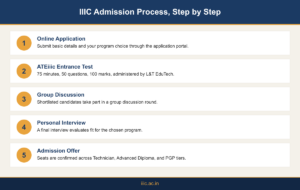
[Alt: Infographic showing the five step IIIC admission process from application through entrance test, group discussion, interview, and admission offer] | IIIC’s admission process from application to seat offer
How the 2026 Cycle Illustrates a Typical Timeline
As a reference point for how IIIC’s annual cycle is generally structured, the 2026 application portal opened in April, with ATEiiic registration running through the following months before closing in late July, ahead of the entrance test, group discussion, and interview stages. This roughly four month application window is typical of how the institute paces intake ahead of a new academic year.
A four month window sounds generous, but seat caps mean the effective window for a specific popular program is often shorter in practice. Since each program carries its own fixed seat count, whether 40 for PGP and Advanced Diploma tiers or 30 for Technician level, a program that draws strong early interest can reach capacity well before the formal registration close date, even while the official window is technically still open for less competitive programs.
By the time you are reading this, the specific 2026 window described above may already be closed. That does not mean admissions are closed generally, institutes commonly run more than one intake point across programs and years. The reliable move is to check the live admissions page or directly contact the admissions team for the current status rather than assuming based on any single article, including this one.
How to Apply and What to Prepare
When a window is open, you can start the process directly by choosing to register for a course through IIIC’s portal. Have your qualifying certificates ready, since eligibility verification happens early in the process, and know which specific program within your eligible tier you want, since seats are allocated per program, not generally across a tier.
It is also worth reviewing IIIC’s accreditation and affiliation status and facilities page before applying, particularly if you are relocating to Kollam and need to plan around hostel availability. Making these decisions before an application window opens, rather than during it, generally leads to a smoother process.
If you are applying from outside Kollam, factor in travel and accommodation planning alongside the academic steps. The group discussion and interview stage typically requires an in person visit, so knowing your travel logistics ahead of receiving a shortlist notification means you are not scrambling once you clear the entrance test.
Conclusion
IIIC’s admissions process is deliberately structured: eligibility by tier, an ATEiiic entrance test, a group discussion, and an interview, not an open enrollment form. Understanding that structure, and treating any specific dates you encounter, including the 2026 cycle discussed here, as illustrative rather than guaranteed current, puts you in a stronger position to apply at the right moment. Whether you are eyeing a Technician certificate, a 6 month Advanced Diploma, or a 1 year PGP program, the preparation is the same: confirm your eligibility against the specific program, not just the tier, and get ready for a genuine assessment rather than a formality. Check the live admissions page or contact the admissions team directly to confirm what is open right now.
Frequently Asked Questions
- What are the three admission tiers at IIIC?
IIIC admits across Managerial/PGP (1 year, engineering degree required), Advanced Diploma (6 months, degree/diploma plus experience), and Technician (short-term, SSLC or Plus One).
- What is the ATEiiic entrance test?
ATEiiic is IIIC’s entrance assessment, administered by L&T EduTech, running 75 minutes across 50 questions worth 100 marks, followed by a group discussion and interview.
- How many seats are available per program?
PGP and Advanced Diploma programs offer 40 seats each, while Technician level programs offer 30 seats each.
- When does the IIIC application portal open?
Exact dates change each intake cycle. The 2026 cycle opened in April, but you should always confirm current dates on the live admissions page rather than relying on a past cycle.
- What documents do I need to apply?
You will need your qualifying certificates for eligibility verification, which vary by tier, from SSLC/Plus One for Technician level to a full engineering degree for PGP level.
- Is there an interview as part of admissions?
Yes. After clearing the ATEiiic entrance test, candidates go through a group discussion and a personal interview before final seat offers are made.
- Can I apply if I missed the stated deadline?
Contact IIIC’s admissions team directly. Institutes often run additional intake points across the year, so a closed window for one cycle does not necessarily mean admissions are closed entirely.
- Does IIIC provide hostel accommodation for admitted students?
Yes, IIIC operates a residential campus with hostel facilities for students relocating to Kollam. See the facilities page for details.
- Who manages IIIC as an institution?
IIIC operates as a Centre of Excellence under the Kerala Academy for Skills Excellence, in partnership with ULCCS, a long standing Kerala worker cooperative.
- How do I contact IIIC with admissions questions?
Email admissions@iiic.ac.in or call 8078980000. You can also reach the team through the contact the admissions team page directly.