


How to Choose a BIM Training Institute in Kerala: A Checklist

You are kindly requested to fill out this form and select the course at IIIC that interests you so that we may get in touch with you as soon as admissions are open.
Choosing a bim training institute kerala option is harder than it looks, because almost every provider makes the same three claims: industry expert faculty, placement assistance and the latest software. None of those can be verified from a brochure. What follows is a checklist of things you can actually check before you pay anybody, applied to modelling training specifically rather than to education in general.
Key Takeaways
- Ask for an affiliation you can look up rather than a logo on a page, and check it against the issuing body directly.
- Judge the syllabus on how much time sits outside authoring software, because coordination and exchange skills are what separate candidates at interview.
- Ask what a graduate leaves with, since a coordinated project you can talk through is worth more than a certificate on its own.
- Insist on programme level placement figures rather than one institute wide percentage, and ask which employers hired from your specific course.
Check One: An Affiliation You Can Actually Verify
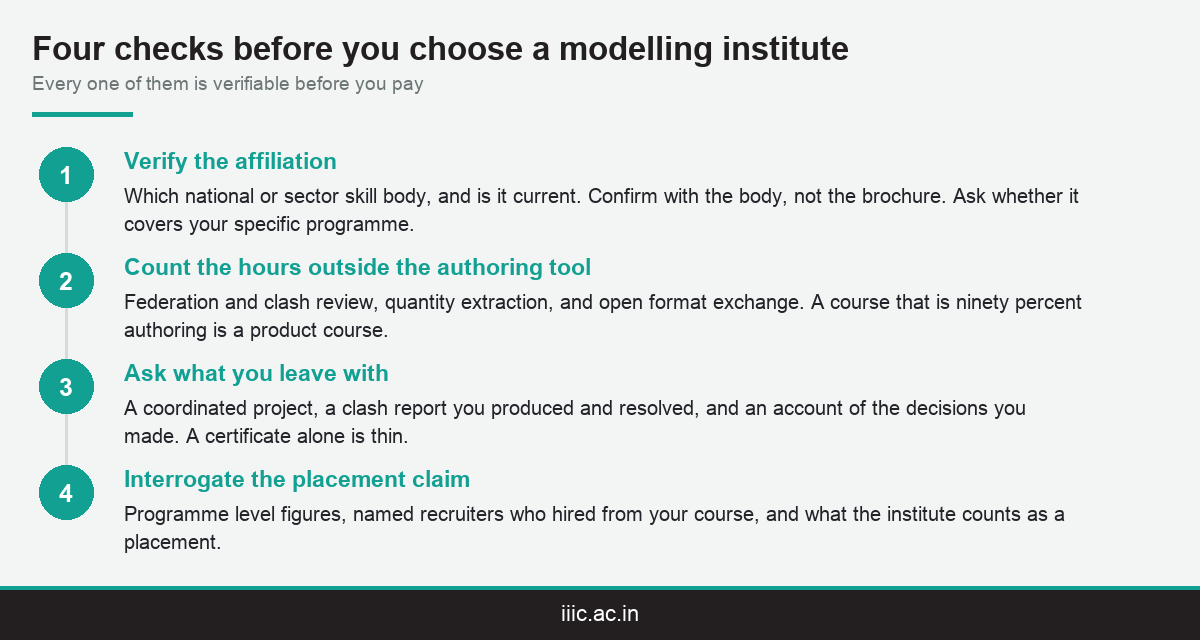
Start here, because it is the only claim on the list that can be checked in five minutes from outside. Ask which national or sector skill body the institute is affiliated with, and then confirm that affiliation is current with the body itself.
Two names matter in this sector. The National Skill Development Corporation is India’s apex public private skill body, and the Construction Skill Development Council of India is the recognised sector council specifically for construction.
An institute affiliated with both is making a checkable claim. An institute that answers this question with the name of a software vendor is telling you something different: that its credential is a product certificate rather than a recognised qualification.
Neither is worthless, but they are not interchangeable. A vendor certificate proves you can drive a tool. A skill body affiliation gives an employer a reference point for what the whole qualification represents.
For IIIC specifically, both affiliations plus its status as a Centre of Excellence under the Kerala Academy for Skills Excellence are listed on IIIC’s accreditation and affiliation page, and it is currently the only Training of Trainers centre in the state.
That last point is worth pausing on. Being certified to train the trainers who then teach elsewhere is a different tier of recognition from being permitted to teach students, and it is straightforward to ask about.
Whatever the answer, write it down and check it. This single question eliminates more weak providers than any other on the list, and it costs you nothing.
One caution. An affiliation held by an institute is not automatically held by every course it runs, since providers commonly mix accredited programmes with unaccredited short courses. Ask specifically whether the programme you are considering carries the affiliation, not just the building it is taught in.
Check Two: How Much of the Course Sits Outside the Authoring Tool
Most modelling courses in the market are authoring courses. They teach you to build geometry in one application, and they stop there. That is a real skill and it is also the most commoditised part of the discipline.
Ask instead how many hours are spent on the other three capability areas: federation and clash review, quantity and data extraction, and information exchange with the open formats that let firms work together.
Coordination review is the clearest differentiator. Plenty of candidates can model. Far fewer can run a clash review, interpret the output, and chair the meeting where the resulting decisions get made and recorded.
Exchange literacy is the second. Understanding how a format such as IFC behaves in practice is what lets a graduate work across firms that do not all hold the same licence.
If the honest answer is that the course is ninety percent authoring, price it accordingly. That is a short course in a software product, and it should not cost what a recognised qualification costs.
Tier matters here too. IIIC teaches modelling at two levels, and the AD BIM programme page and the PGP BIM programme page carry different scopes for different applicants.
Ask which tier the provider is actually offering. Some market a short product course in language that implies a full qualification, and the distinction only becomes clear once you are enrolled.
A related question is who teaches. Ask whether instructors have worked on live projects using the process they are describing, because coordination is one of those subjects where the difference between someone who has run a clash meeting and someone who has read about one is immediately obvious to students.
Check Three: Practical Hours, Equipment and What You Leave With
The third check is about evidence rather than instruction. Ask what proportion of contact time is hands on, what hardware and licences students actually get access to, and what a graduate takes away at the end.
On practical proportion, IIIC puts the hands on share of its training at roughly seventy five percent across the institute, and the computer centre is where that time is spent for this discipline. Ask any provider for their equivalent number.
On access, the question is how many students share a workstation and whether licences are available outside timetabled hours. Modelling is learned by repetition, and a course that limits practice time limits what you can absorb.
On output, ask what you leave with beyond a certificate. A coordinated project you built, a clash report you produced and resolved, and a clear account of the decisions you made are what an interview actually explores.
Assessment method is a good proxy for all three. Programmes assessed on a real project tend to produce graduates who can do the work, because the assessment itself forces the practical problem solving that the job consists of.
A campus visit answers most of this in an afternoon, and it is the single most useful due diligence step available. Walk through the labs, ask to see student output, and notice whether anyone hesitates.
IIIC also runs a separate internship listing for this discipline. The modelling internship is worth asking about, because supervised project time is the most convincing evidence a new graduate can carry into an interview.
Check Four: Placement Claims You Can Interrogate
Placement is where marketing is loosest, and it is also where a few precise questions expose the difference between a real record and a well designed page.
Ask for figures at programme level rather than one institute wide percentage. An institute wide number is an average across courses with very different demand, and it tells you almost nothing about the one you are considering.
IIIC publishes at that level. Reported rates include ninety five percent for advanced construction management, ninety two percent for urban planning design and management, and a hundred percent for the GIS and GPS certificate programme.
Ask next for named recruiters and, specifically, which of them hired from your course in the last cycle. IIIC names Reliance, Ultratech, Berger and Sobha alongside firms such as ESRI India, across more than fifty organisations, on the placement outcomes page.
Then ask what counts as a placement. Some providers count any offer, including unpaid or unrelated roles, and the definition matters more than the percentage attached to it.
Finally, ask to speak to a graduate of the specific programme rather than of the institute in general. One conversation about their first six months in the job settles more than any brochure, and a confident provider will arrange it.
If a provider will not answer these questions in writing, that is your answer. The checklist works because every item is verifiable, and reluctance to be verified is itself useful information about what you would be buying.
Conclusion
Choosing a bim training institute kerala option comes down to four things you can verify: a checkable skill body affiliation, a syllabus that spends real time outside the authoring tool, practical hours with evidence you can carry to an interview, and placement figures published at programme level. Take the same four questions to every provider you shortlist, including IIIC, and compare the answers rather than the marketing. To ask them directly, call 8078980000 or apply online at iiic.ac.in.
Related Reading
Frequently Asked Questions
How do I choose a BIM training institute in Kerala?
Check four things you can verify: a current skill body affiliation, how much of the syllabus sits outside the authoring tool, the practical hours and evidence you leave with, and placement figures published at programme level rather than institute wide.
Is a software vendor certificate the same as a qualification?
No. A vendor certificate proves you can drive a specific tool. A skill body affiliated qualification gives an employer a reference point for what the whole programme represents. They are complementary rather than interchangeable credentials.
What accreditation should a modelling institute have?
In this sector, look for affiliation with India’s apex skill development body and with the recognised construction sector council. Confirm the affiliation is current with the issuing body itself rather than accepting a logo on a webpage.
How much practical time should a course include?
Ask for a number rather than a reassurance. IIIC puts the hands on share of its training at roughly seventy five percent across the institute, which gives you a reasonable benchmark to compare other providers against directly.
What should I leave the course with?
Beyond a certificate, aim to leave with a coordinated project you built, a clash report you produced and resolved, and a clear account of your decisions. That is what an interview actually explores in any real hiring conversation.
Why do placement percentages vary so much between institutes?
Because the definition varies. Some providers count any offer, including unpaid or unrelated roles. Ask what counts as a placement, at programme level, and which named employers hired from your specific course in the last cycle.
Which IIIC tier should I apply to?
The six month diploma suits applicants with a degree or diploma plus around three years of experience. The one year postgraduate tier generally requires a B.Tech or BE in Civil Engineering or Architecture instead of that work experience.
Can I visit before deciding?
Yes, and it is the most useful step available. Walk through the labs, ask to see student output, and use the enquiry form to arrange it. An afternoon on campus answers what no brochure can honestly convey.
Does an institute need its own labs for this subject?
For modelling, workstation and licence access matters more than heavy equipment. Ask how many students share a machine and whether licences are available outside timetabled hours, since repetition is how the skill is genuinely built.
How long does the IIIC application process take?
Applications run through an online form, the ATEiiic entrance assessment, a group discussion and then an interview. Current dates sit on how to apply to IIIC, and the whole sequence usually takes several weeks rather than days to complete.