

PGP in BIM: Software Tools and Curriculum Deep Dive
You are kindly requested to fill out this form and select the course at IIIC that interests you so that we may get in touch with you as soon as admissions are open.
A pgp bim course asks for a year of your life, and applicants reasonably want to know what that year is spent on before committing. The short answer is that the postgraduate tier is not a longer version of the six month diploma. It adds the process and coordination layer that turns a competent modeller into somebody who can run a modelling workflow across several parties. This guide covers what that means in practice.
Key Takeaways
- The postgraduate tier runs one year with forty seats, and generally requires a B.Tech or BE in Civil Engineering or Architecture at entry.
- Its distinguishing content is process governance: what information enters the model, at what stage, at what level of detail, and who is accountable for it.
- Software should be judged as four capability categories rather than as a product list, because employers hire against categories.
- IIIC lists this programme under a digital project management slug, so search for the programme name rather than the URL if you are looking for it directly.
Where the Postgraduate Modelling Tier Sits at IIIC
IIIC runs nineteen programmes across three tiers, and modelling appears at two of them. A pgp bim course sits in the seven programme managerial tier, alongside advanced construction management, road construction management and building services.
The tier sets the entry bar. Postgraduate programmes generally require a B.Tech or BE in Civil Engineering or Architecture, so applicants arrive already fluent in the construction fundamentals that the modelling process is applied to.
One year is the format, capped at forty seats. Popular specialisations can close before a published deadline, and the admission sequence runs from an online application through the ATEiiic assessment to a group discussion and an interview.
One practical note that trips people up. IIIC lists the postgraduate modelling programme under a digital project management URL rather than a modelling one, so the PGP BIM programme page is where the current terms actually live.
The alternative route is the six month Advanced Diploma, which covers the same subject at a different depth and with different eligibility. Its terms sit on the AD BIM programme page.
If you have not yet settled on modelling at all, IIIC publishes the primer on digital construction models, which is a better starting point than this deep dive for anyone still deciding whether the discipline suits them.
The distinction between the tiers is worth restating plainly, because it is the single most common source of misdirected applications. Six months trains a specialist who produces good models. Twelve months trains somebody expected to hold a modelling process together across an entire project team.
What the Extra Six Months Actually Buys
The technical content of modelling can be taught in six months to somebody with a construction background. What cannot be compressed into that time is the process layer, and that is what the postgraduate year is for.
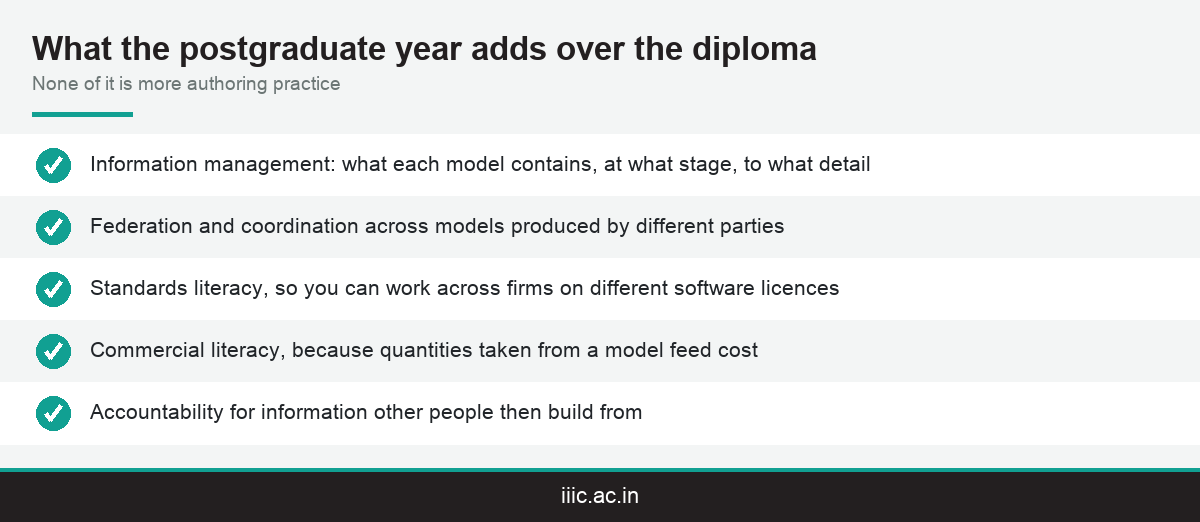
Information management is the first piece. On a real project, somebody decides what each model must contain at each stage, what level of detail is appropriate, and how that information is delivered to the client at handover.
Coordination is the second. Structural, architectural and services models are produced by different parties, and combining them into a clash free federated model is a workflow problem as much as a technical one.
Standards are the third. Working knowledge of how open exchange formats such as IFC behave is what lets a coordinator work across firms that do not share a software licence.
Commercial literacy is the fourth and least discussed. Quantities taken from a model feed cost, and a coordinator who does not understand how measurement is used downstream tends to produce models that are geometrically correct and commercially useless.
Finally, there is the question of accountability. A modelling lead signs off information that other people then build from, and that responsibility is the real reason the tier asks for an engineering or architecture degree at entry rather than simply for experience.
None of this is visible from a syllabus list, which is why it is worth asking the admissions team directly how much of the year is spent on process and coordination rather than on authoring geometry.
The Software Categories the Field Expects
Applicants almost always ask about software by product name. Employers almost never hire that way. They hire for four capability categories, and the specific product varies between firms, clients and even individual projects.
The first category is authoring. This is where geometry and data are created, and it is the category most people mean when they ask about a Revit course in Kerala. It is necessary and it is also the least differentiated skill of the four.
The second is federation and clash review, typically handled in a review environment such as Navisworks. Being able to run a coordination review, interpret the results and chair the meeting that follows is far rarer than being able to model.
The third is data and quantity extraction. Schedules, quantities and parameter management sit here, and this is the category that connects modelling to cost, procurement and progress measurement.
The fourth is exchange and documentation: producing drawings from the model, issuing information in open formats, and maintaining the record set a client receives at completion.
When you compare programmes, ask how many hours sit in each category rather than which products appear on the brochure. A programme heavy on authoring and light on the other three produces graduates who can model and cannot coordinate.
IIIC puts the hands on share of its training at roughly seventy five percent across the institute, and the computer centre is where that proportion is spent for this discipline rather than in a lecture theatre.
Internships, Placement and What Graduates Do Next
Software familiarity on its own is not evidence. What converts it into something an employer will interview against is a project you can talk through, which is why the internship attached to this discipline is worth asking about specifically.
The modelling internship is listed separately from the programme itself. Ask the admissions team how it is allocated and what a student typically produces during it.
On outcomes, IIIC publishes placement figures at programme level rather than as one institute wide claim. Reported rates include ninety five percent for advanced construction management and a hundred percent for the GIS and GPS certificate programme.
Named recruiting partners across the institute include Reliance, Ultratech, Berger and Sobha alongside firms such as ESRI India, spanning more than fifty organisations. The placement outcomes page carries the current list.
Graduate roles from this tier tend to be coordination shaped: modelling coordinator, information manager, or the technical role on a design or contracting team that owns the federated model and the clash process around it.
That is a different destination from the diploma tier, which more often leads to production modelling roles inside a discipline team. Both are real careers, and the difference is worth being clear about before you choose a tier.
The overseas question comes up often. A credential mapped to a recognised national skill body is easier to explain to an employer abroad than an unaccredited certificate, though no institute can promise a particular posting.
Whichever tier you pick, leave the programme with something you can show. A coordinated project, a clash report you produced and resolved, and a clear account of the decisions you made will carry an interview further than a list of software you have touched, and it is the part applicants most often neglect to plan for.
Conclusion
A pgp bim course is worth twelve months only if coordination is where you want to end up. The postgraduate tier at IIIC assumes an engineering or architecture degree, spends its additional time on information management, federation and standards rather than on more authoring practice, and points graduates at coordinator and information manager roles. If production modelling is your goal instead, the six month diploma is the better value route. Read the programme page for current terms, or call 8078980000 to talk the tier choice through.
Related Reading
Frequently Asked Questions
What is the PGP BIM course at IIIC?
It is the one year postgraduate modelling programme in IIIC’s managerial tier. It covers authoring plus the process layer above it: information management, model federation, clash coordination and the standards that let firms exchange models cleanly.
How is it different from the six month diploma?
The diploma trains a specialist who produces good models within one discipline. The postgraduate year trains somebody expected to run a modelling process across several parties, which is a coordination job rather than a production one.
What qualification do I need to apply?
The postgraduate tier generally requires a B.Tech or BE in Civil Engineering or Architecture. Applicants from other backgrounds should consider the six month Advanced Diploma, where eligibility is built around a degree plus around three years of work experience.
Which software will I be taught?
Think in four categories: authoring, federation and clash review, data and quantity extraction, and exchange and documentation. Confirm the current tool list on the programme page, since specific products are revised between intake cycles at every institute.
Do I need modelling experience before I apply?
No, but construction literacy helps considerably. The strongest applicants tend to be those who already understand how a building goes together, because the year then adds process and coordination on top of that existing foundation.
Is there an internship attached to the programme?
IIIC lists a separate modelling internship, and it is worth asking the admissions team how it is allocated. A project you can talk through at interview is worth more than any certificate on its own when employers assess you.
Why is the programme listed under a digital project management URL?
The postgraduate modelling programme sits at a digital project management address on the IIIC site while carrying the modelling programme name. Search for the programme name rather than the URL if you are trying to find it directly.
What roles do graduates typically move into?
Coordination shaped roles are the usual destination: modelling coordinator, information manager, or the technical position on a design or contracting team that owns the federated model and the clash process built around it for the project team.
How many seats are there and how do I apply?
Intake is capped at forty seats. Applications run through an online form, the ATEiiic assessment, a group discussion and then an interview, with current intake dates published on the admissions page rather than in any article.
Is the training mostly practical?
IIIC puts the hands on share of its training at roughly seventy five percent across the institute. For this discipline that means time in the computer centre working on coordinated projects rather than sitting through lectures about them.