

BIM Course in Kerala: IIIC’s Professional Training Guide
You are kindly requested to fill out this form and select the course at IIIC that interests you so that we may get in touch with you as soon as admissions are open.
Choosing the right BIM course in Kerala can define your career in the state’s fast growing infrastructure sector. Building Information Modeling is now a mandatory skill on many government tenders, and employers actively look for candidates trained on real project workflows, not theory alone. The Indian Institute of Infrastructure and Construction, a government backed institute in Kollam, runs structured BIM and Revit programs built around 75 percent practical training. This guide explains what a strong BIM training institute Kerala should offer, how IIIC’s programs compare, and what career outcomes you can expect after graduation.
Key Takeaways
- IIIC offers two BIM course in Kerala options: the Postgraduate Diploma (PGP BIM) for graduate engineers and architects, and the Advanced Diploma (AD BIM) for faster, entry level upskilling.
- Government backing under KASE and an NSDC certified curriculum give this Revit course Kerala credibility that private training centers cannot match.
- A 75 percent hands on training model means graduates leave with an active project portfolio, not just software familiarity.
Why BIM Skills Are Becoming Non Negotiable in Construction
India’s largest infrastructure and metro rail tenders increasingly require BIM compliant documentation, pushing steady demand for trained coordinators across contractor and consultancy teams. Engineers and architects without Revit and clash detection skills risk exclusion from bid teams entirely, and formal training now matters more than a self taught approach ever could.
Government agencies across India are adopting BIM mandates modeled on international public works standards. Public infrastructure bodies now ask contractors to submit coordinated 3D models before construction begins, reducing rework and cost overruns. This shift means civil engineers, architects, and quantity surveyors need working knowledge of Building Information Modeling, not just familiarity with the term. Employers on metro rail, highway, and large building projects prefer candidates who can build, coordinate, and clash test models in Revit rather than draft in 2D alone. Public works departments increasingly cite BIM compliance in tender documents, mirroring practices already standard in the United Kingdom and parts of the Gulf. Contractors bidding on hospital, airport, and metro projects must show a qualified BIM team before approval, and that expectation is starting to reach mid sized private developers as well. Kerala’s own infrastructure push, backed by agencies like CSDCI and IESC, is following this trend closely. For engineers already working on site, this creates real pressure to upskill quickly rather than wait for employer sponsored training that may never arrive. Fresh graduates who complete a structured BIM course in Kerala position themselves ahead of peers who rely only on college coursework, since most engineering curricula still treat BIM as an elective rather than a core skill.
PGP BIM vs Advanced Diploma: Choosing the Right Program
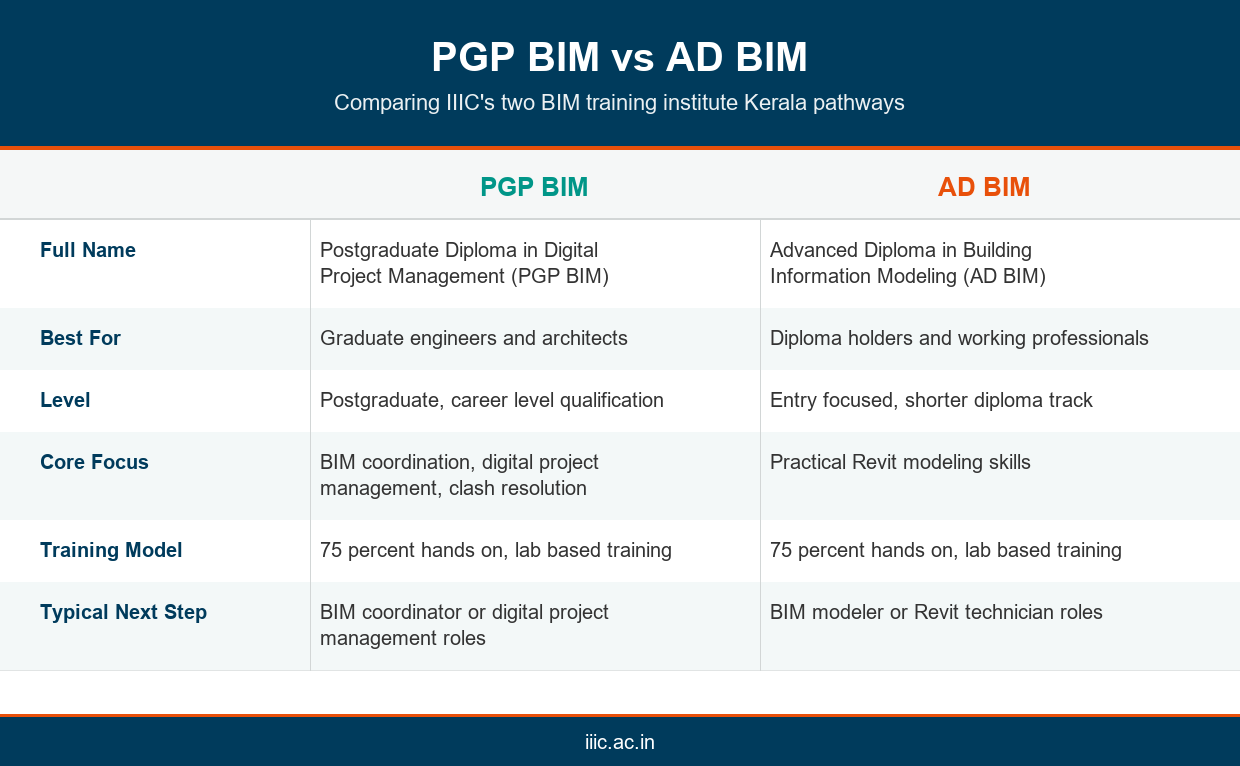
IIIC runs two distinct BIM training institute Kerala pathways so candidates at different career stages can enter at the right level, rather than following one generic curriculum built only for beginners with no prior exposure to construction or design software.
The Postgraduate Diploma in Digital Project Management, IIIC’s PGP BIM program, suits graduate engineers and architects who want a comprehensive, career level qualification covering BIM coordination, digital project management, and multidisciplinary clash resolution. It runs longer than the diploma track and is built for candidates who plan to lead BIM implementation on projects rather than only operate the software day to day. The Advanced Diploma in Building Information Modeling, known as AD BIM, is a shorter, entry focused track for diploma holders and working professionals who need practical Revit skills quickly, without committing to a full postgraduate schedule. Both programs sit within IIIC’s wider offerings alongside quantity surveying, GIS, and construction management diplomas, so students can combine BIM training with adjacent skills that employers on large infrastructure projects tend to value together. Choosing between them depends mostly on your current qualification, how quickly you need to enter the workforce, and whether you are aiming for a coordination role or a hands on modeling role in your next position.
What You Learn in a Revit Course Kerala Employers Trust
A credible Revit course Kerala goes beyond basic modeling commands to teach coordination, documentation, and clash detection workflows that mirror real consulting and contracting environments, not isolated tutorial style software lessons recorded years ago.
IIIC structures its Revit training around live project scenarios rather than isolated exercises. Students learn architectural and structural modeling, drawing sheet generation, and multidisciplinary coordination using Revit alongside supporting tools such as Navisworks for clash detection. Coursework also introduces model based quantity extraction and basic scheduling, since employers increasingly expect BIM trained staff to support cost and timeline estimation, not just visual modeling. Faculty draw on industry experience with ULCCS projects and NSDC-CSDCI certified trainers, so classroom exercises reflect actual site documentation requirements rather than textbook scenarios. Because the program is NSQF aligned, learning outcomes map to recognized skill levels that employers and government agencies can verify independently, rather than taking a certificate at face value. Assessments are project based rather than purely written, so students must deliver a complete, coordinated model rather than answer multiple choice questions about Revit menus and toolbars. Graduates leave with a working model portfolio they can present in interviews, which matters more to hiring managers than a certificate alone ever could.
Career Outcomes After a BIM Course in Kerala
Placement support, industry partnerships, and NSDC certification give IIIC graduates a credibility advantage when applying to consulting firms, contractors, and government backed projects, both within Kerala and in Gulf infrastructure markets that actively recruit trained Indian talent.
IIIC’s placement cell works with construction, MEP, and consulting employers who value NSQF aligned, NSDC certified training over generic software certificates earned through short online courses. Because the institute operates under the Kerala Academy for Skills Excellence and is supported by ULCCS, graduates carry a government recognized credential that many private training centers cannot offer. Industry partnerships with CSDCI, IESC, and RICS India strengthen this further, connecting coursework to recognized professional standards used across the industry. Working professionals who add a BIM course in Kerala to an existing civil engineering or architecture background typically qualify for BIM coordinator, modeler, or digital project management roles, among the fastest growing titles in Indian construction recruitment today. Many graduates also find that BIM skills open doors to remote or hybrid roles with international consultancies, since coordinated 3D models can be reviewed and updated from anywhere, widening the job market well beyond Kerala’s own construction sector.
Eligibility, Duration, and How to Apply
Both the PGP BIM and AD BIM programs have defined eligibility criteria based on your existing qualification, and applying early matters because IIIC keeps intake numbers limited to protect the quality of its hands on, lab based training model.
Graduate engineers and architects typically qualify for the PGP BIM program, while diploma holders and working professionals can enter through the Advanced Diploma track. Both pathways run on IIIC’s nine acre Kollam campus, where 75 percent of training time goes into practical, lab based work rather than lectures delivered from a textbook. Because cohort sizes are kept small to protect hands on instruction quality, prospective students should check the full course catalog and confirm intake dates before applying, since batches fill up faster than many applicants expect. Working professionals with site experience can also explore recognition of prior learning routes into related diploma programs, a distinctive feature of IIIC’s admissions approach compared with standalone software training centers that only sell software licenses and short tutorial videos without any structured assessment. Admissions counsellors can also advise on combining a BIM course with a related diploma, such as quantity surveying, for candidates who want a broader digital project management skill set rather than modeling alone.
Conclusion
A recognized BIM course in Kerala is no longer optional for engineers and architects who want to stay competitive on government and private infrastructure projects. IIIC’s PGP BIM and AD BIM programs combine NSQF aligned curriculum, NSDC certification, and 75 percent practical training with placement support that generic online courses cannot replicate. Whether you are a fresh graduate or a working professional moving into digital project management, choosing a government backed, industry connected institute matters. Explore IIIC’s PGP BIM program today and apply before the next intake closes to secure your seat at Kerala’s leading BIM training institute.
Frequently Asked Questions
What is BIM and why is it taught in a BIM course in Kerala?
Building Information Modeling, or BIM, creates a coordinated digital model of a structure before construction begins. IIIC’s BIM course in Kerala teaches students to build, coordinate, and troubleshoot these models using industry standard software such as Revit and Navisworks.
What is the difference between the PGP BIM and AD BIM programs?
The PGP BIM, formally the Postgraduate Diploma in Digital Project Management, suits graduate engineers and architects seeking a comprehensive qualification. The AD BIM, or Advanced Diploma in Building Information Modeling, is a shorter track for diploma holders and working professionals.
Who is eligible for IIIC’s Revit course Kerala programs?
Graduate engineers and architects typically qualify for the PGP BIM program, while diploma holders and working professionals can enter through the Advanced Diploma. RPL candidates with relevant site experience may also apply through recognition of prior learning routes.
How much of IIIC’s BIM training is hands on practice?
IIIC follows a 75 percent practical training model across its programs. Students spend most contact hours building Revit models, running clash detection exercises, and preparing coordinated drawing sets rather than sitting through lecture only sessions.
Does IIIC offer placement support after the BIM course?
Yes. IIIC operates a dedicated placement cell connecting graduates with construction, MEP, and consulting employers across Kerala and beyond. Government backing under KASE and industry partnerships with CSDCI and IESC give graduates added credibility during hiring and salary negotiations.
How does BIM training connect with quantity surveying careers?
BIM increasingly integrates with quantity surveying, since coordinated models now generate material takeoffs and cost estimates automatically. Students interested in this crossover can explore IIIC’s Advanced Diploma in Quantity Surveying and Contracts Management alongside their BIM training.
Is IIIC’s BIM training institute Kerala program government recognized?
Yes. IIIC operates under the Kerala Academy for Skills Excellence, a Government of Kerala initiative, and its programs are NSQF aligned and NSDC certified. This gives graduates a credential recognized well beyond private software training centers.
What software do students learn in the Revit course Kerala curriculum?
Students primarily train on Autodesk Revit for architectural and structural modeling, supported by Navisworks for clash detection and coordination. The curriculum also introduces broader digital project management tools used daily on live infrastructure and building projects across Kerala.
Can working professionals join the BIM course without leaving their job?
IIIC’s Advanced Diploma track is designed for working professionals who need practical upskilling without a lengthy career break. Applicants should confirm current batch timings and intake dates directly with the institute, since scheduling can vary by cohort.
How long does it take to complete IIIC’s BIM course in Kerala?
Duration varies by track. The Advanced Diploma is a shorter, entry level program, while the Postgraduate Diploma in Digital Project Management runs longer to cover advanced coordination and project management topics in real depth and detail.